
.png)
TL;DR
- Instead of chasing isolated CRO hacks, Shopify operators can run a structured 5-stage audit that maps every revenue leak in the funnel to a verified industry benchmark, enabling teams to compound conversion improvements across multiple quarters.
- The strongest leak points sit at 5 measurable stages: homepage, collection page, product page, cart, and checkout. Each stage has a documented benchmark and a specific fix backed by primary research from Baymard Institute, Spiegel Research Center, Google, and McKinsey.
- A conversion audit works best as a controlled workflow with priority ordering (product page first), 14-day measurement windows, and native Shopify integrations rather than scattered tactics applied at random.
Introduction
Shopify merchants are being asked to do more with the same traffic. As paid acquisition costs rise and organic search shifts toward AI-powered answers, the difference between a successful store and a struggling one increasingly comes down to one metric: conversion rate. Across direct-to-consumer brands, multi-product catalogs, and subscription stores, the pressure to extract more revenue from existing sessions has never been higher. This shift is part of a broader movement toward data-driven Shopify conversion rate optimization, where operators use measured benchmarks instead of gut feel to allocate effort.
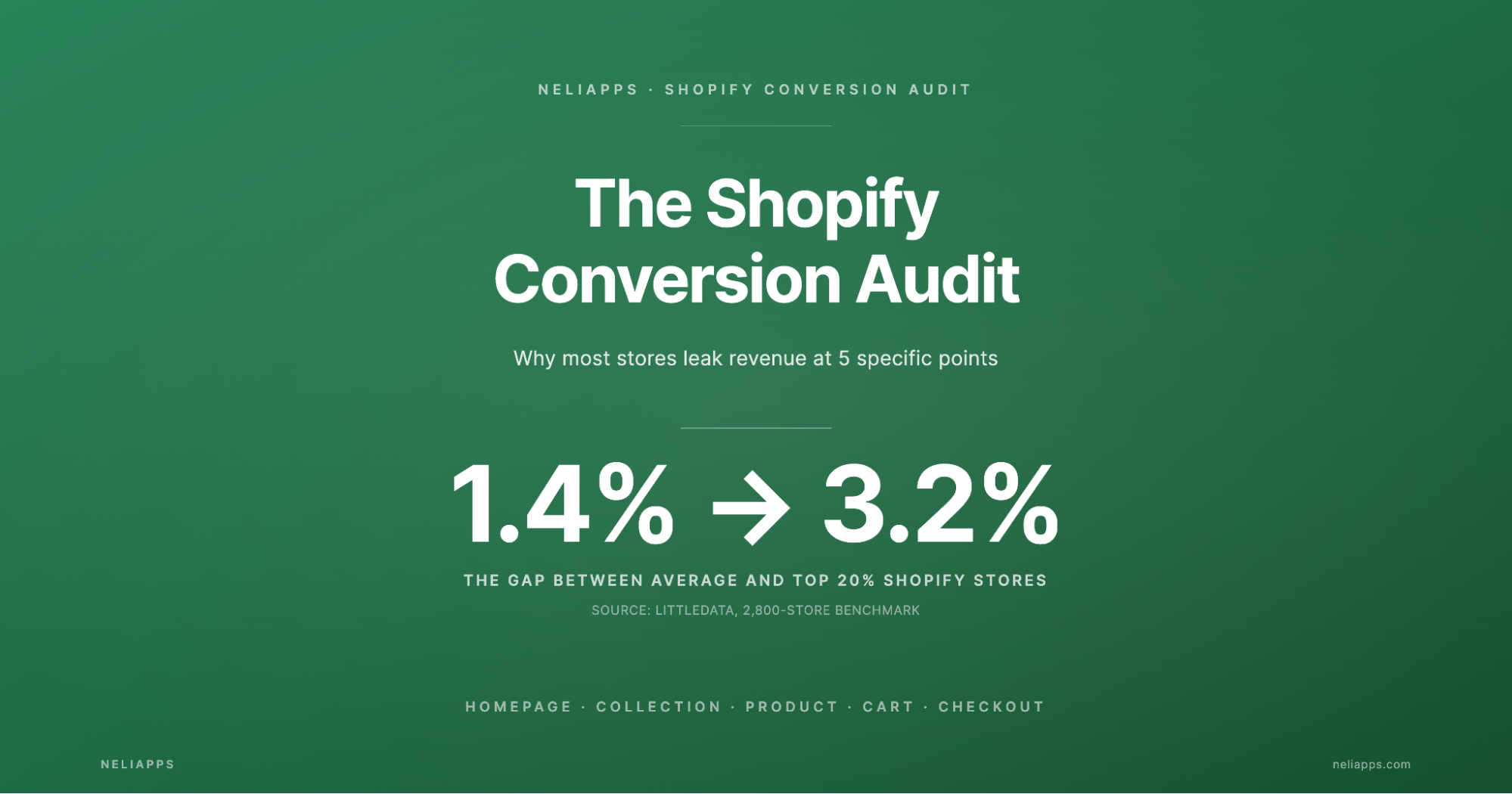
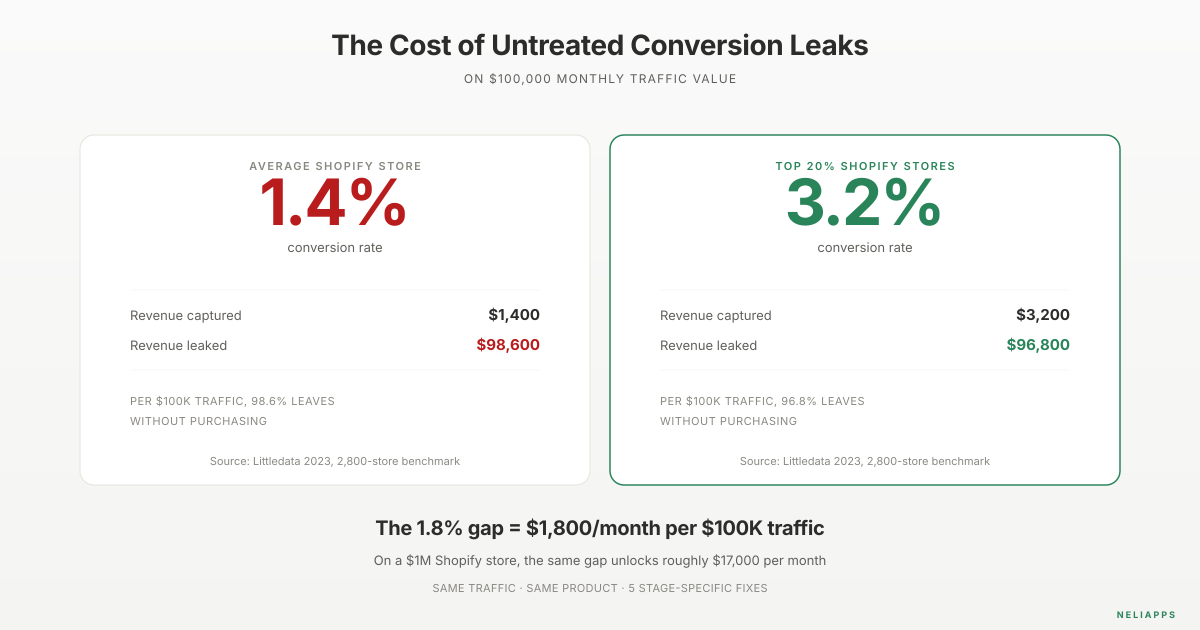
Despite this pressure, most CRO advice remains tactical and reactive. Teams chase isolated hacks instead of running a structured audit. According to Littledata's 2023 benchmark study covering 2,800 Shopify stores, the average conversion rate sits at 1.4% while the top 20% reach 3.2%. On a $1 million store, that gap translates to roughly $17,000 in additional monthly revenue.
A structured audit helps Shopify operators move from scattered tactics to a measurable workflow. It maps the funnel into 5 leak points, ties each leak to verified data, and prescribes a specific fix. It is especially valuable for merchants who have already exhausted easy wins and need a systematic approach to compound improvements over multiple quarters.
CRO does not replace product-market fit or paid acquisition strategy. Instead, it creates a measurable framework that founders, marketers, and operators can execute against. This stage-by-stage approach has emerged as the standard for serious Shopify optimization, where Baymard's checkout usability research and Google's site speed studies have replaced gut-feel optimization with measured benchmarks.
What Is the Shopify Conversion Audit?
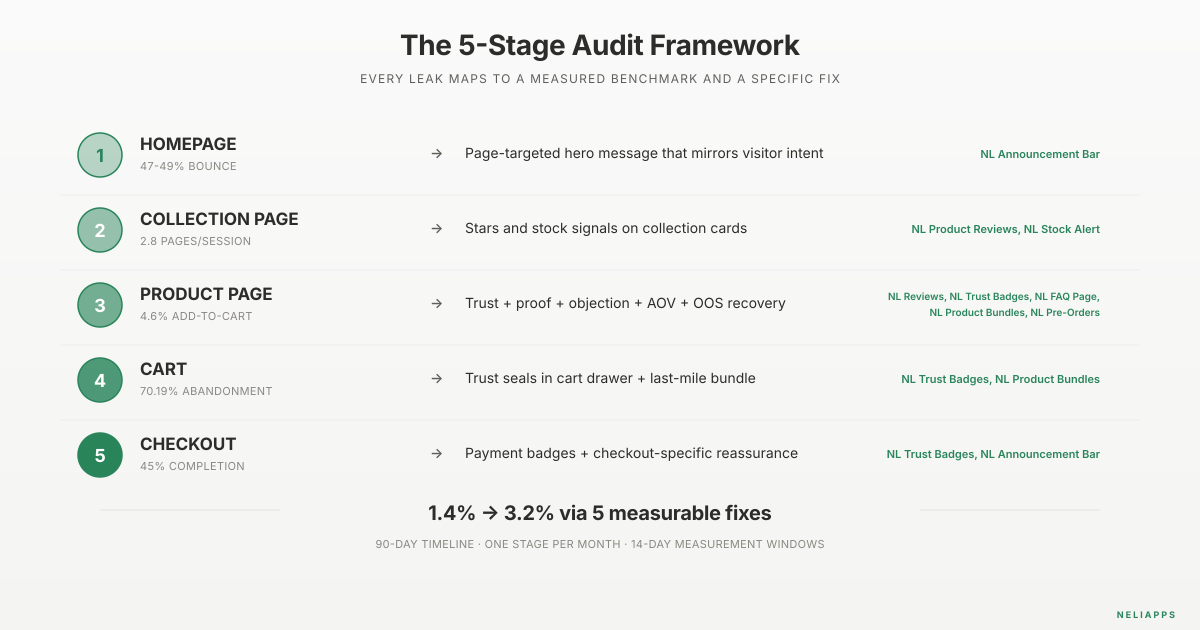
The Shopify Conversion Audit is a structured CRO framework that maps a store's full funnel into 5 measurable revenue leak points: homepage, collection page, product page, cart, and checkout. Each leak corresponds to a specific stage rate documented in primary CRO research, including Littledata's benchmarks, Baymard's cart abandonment data, and the Spiegel Research Center's findings on social proof.
In practice, an audit identifies which stage in the funnel is leaking the most revenue, prescribes a specific app or technical fix, and recommends a 14-day measurement window before moving to the next stage. Research from Baymard Institute's checkout usability testing highlights how stage-specific optimization can produce a measurable 35.26% conversion lift through better checkout design alone, which makes structured auditing one of the highest-ROI activities for any Shopify operator.
The Hidden Cost of Untreated Conversion Leaks
Compounded Traffic Waste
One of the largest hidden costs in Shopify operations is the revenue lost from traffic that already arrived. Littledata's 2023 benchmark shows the average Shopify store converts at 1.4%, meaning 98.6% of paid and organic traffic leaves without purchasing. For a store spending $10,000 per month on Google Ads, lifting conversion from 1.4% to 2.0% unlocks roughly 43% more revenue from the same ad budget.
Wasted High-Intent Sessions at Cart and Checkout
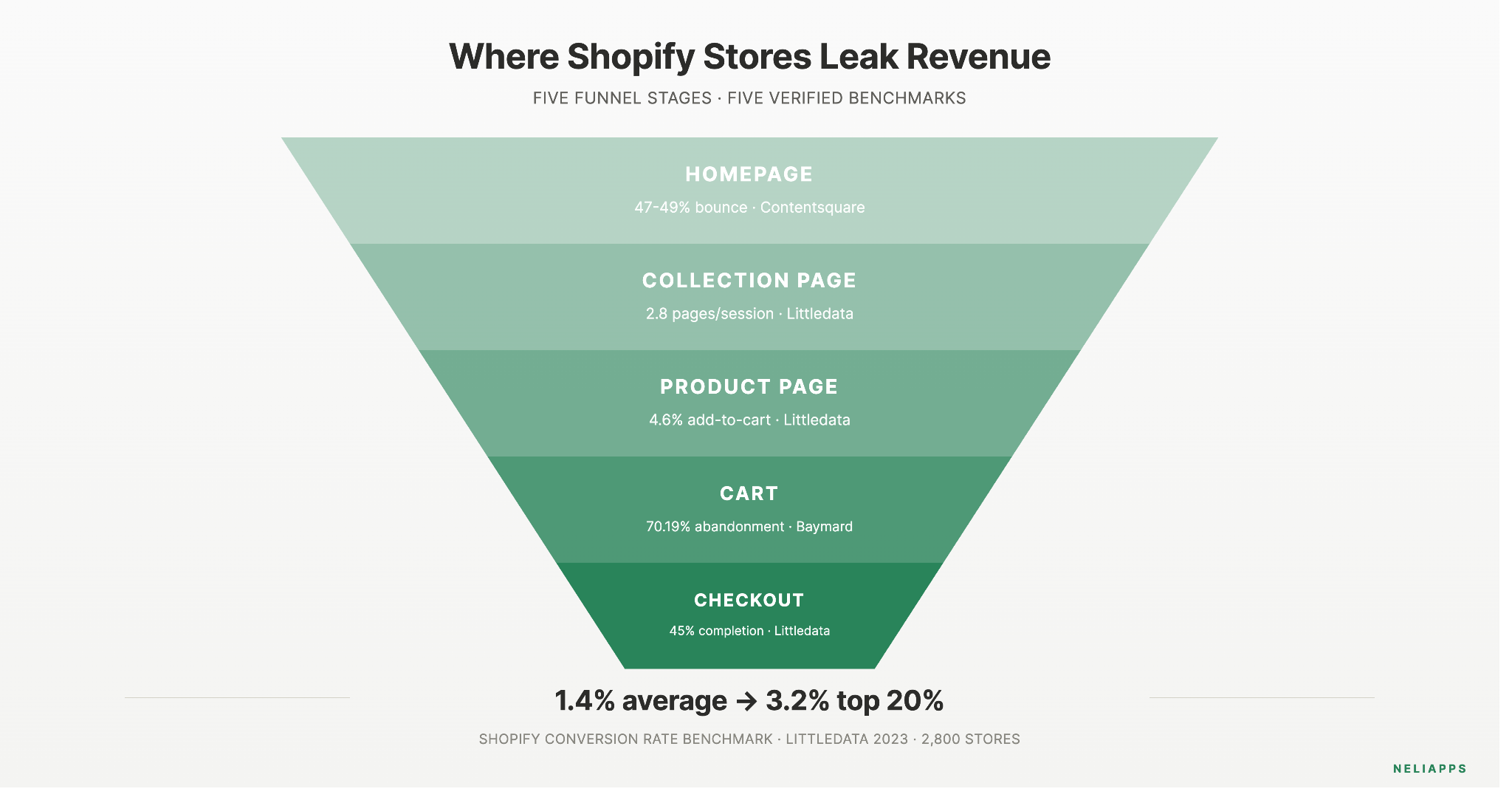
The cart and checkout stages waste the most expensive visitors a Shopify store has. Baymard Institute's 2025 weighted average puts the global Shopify cart abandonment rate at 70.19%, meaning seven out of ten shoppers who added an item to cart never completed the order. The leading causes include extra costs at checkout (48%), forced account creation (26%), and credit card security concerns (25%).
Inconsistent Trust Signals Across Pages
As Shopify stores scale their product catalogs, maintaining consistent trust and social proof becomes harder. Different product pages may show different review widgets, different trust badges, or no signals at all. Baymard documented that 70% of ecommerce sites lack the ideal combination of site-authored FAQs and community Q&As on product pages, leading to off-site research that often ends at a competitor's product page. Inconsistency at scale becomes a tax on every product the store adds.
Page Load Friction at the Highest-Intent Moments
A manual approach to site speed often misses checkout-specific bottlenecks. Google's joint study with Deloitte found that a 0.1 second improvement in mobile site speed increased retail conversions by 8.4% and average order value by 9.2%. Portent's analysis of 100 million pageviews across 20 ecommerce sites showed sites loading in 1 second converted at 3.05% versus 1.08% at 5 seconds. Slow pages at the wrong stage compound abandonment across every other leak in the audit.
How the 5-Stage Conversion Audit Works
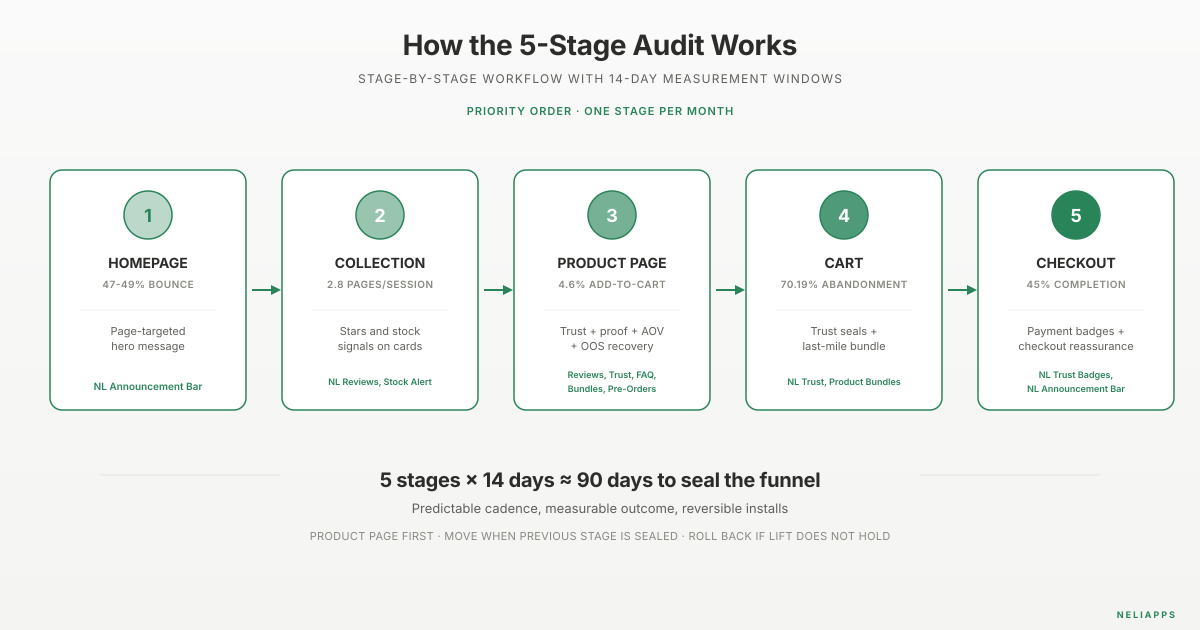
The conversion audit is not a single tactic. It is a structured 5-stage workflow that maps each funnel stage to a documented benchmark, a specific fix, and a measurement window. While implementations vary by store, every audit follows the same priority order: identify the stage with the largest gap to benchmark, install the corresponding app, measure in 14-day windows, then move to the next stage.
Stage 1: Homepage
The homepage carries the first impression. Contentsquare's Digital Experience Benchmark puts average ecommerce bounce rate at roughly 47 to 49%. The leak happens when the homepage shows a generic message that does not mirror visitor intent from the traffic source. The fix is page-specific messaging through a configurable announcement bar that swaps content based on traffic source, campaign, or page. Apps like NL Announcement Bar deliver this through per-page targeting and gradient design on the Shopify App Store.
Stage 2: Collection page
The collection page is the underrated CRO surface where browsers click into a product or leave. Average pages per session on Shopify sits at 2.8 (Littledata), meaning shoppers scan very few products before deciding. The fix layers two signals on collection cards. The first is star ratings, where the Spiegel Research Center documented a 270% purchase-likelihood lift for products with at least 5 reviews. The second is stock cues with "Notify me when back" email capture for out-of-stock items, and Omnisend's 2026 email benchmark reports back-in-stock emails converting at 6.72%, the highest of any automated email type. Apps like NL Product Reviews and NL Stock Alert handle both signals.
Stage 3: Product page
The product page is where the decision happens or stalls. The average add-to-cart rate sits at 4.6% (Littledata), with top stores above 7.5%. Shopify product page optimization is therefore the highest-leverage work in the audit. The fix layers reviews to capture the Spiegel 270% lift, trust badges within 100 pixels of the buy button to address the 18% of US shoppers who abandon orders due to credit card security concerns (Baymard), embedded FAQs answering the top objections, related-item bundles for AOV lift, and pre-order recovery for stockouts. NL Product Reviews, NL Trust Badges, NL FAQ Page, NL Product Bundles, and NL Pre-Orders each address one layer of this fix.
Stage 4: Cart
The cart stage is where trust collapses at the moment of friction. The Baymard 2025 weighted average puts the Shopify cart abandonment rate at 70.19%. The fix places visible trust seals (money-back guarantee, secure checkout, return policy) inside the cart drawer through NL Trust Badges, and adds a last-chance bundle suggestion before the checkout button through NL Product Bundles.
Stage 5: Checkout
The checkout stage is where any friction kills the sale. Top Shopify stores complete checkout at 66 to 70% for desktop (Littledata top-decile) versus 45% for the average store. The fix combines payment method badges and security signals near payment fields through NL Trust Badges, and a checkout-specific announcement bar confirming shipping cost or ETA through NL Announcement Bar.
Use Cases for Conversion Optimization in Shopify Stores
Direct-to-consumer brands
DTC brands face the highest customer acquisition costs of any Shopify segment. A 0.5%age point lift on conversion rate often pays for the entire CRO investment within the first quarter. The strongest leverage typically sits at the product page (reviews + trust badges) and at the cart (trust seals + bundles).
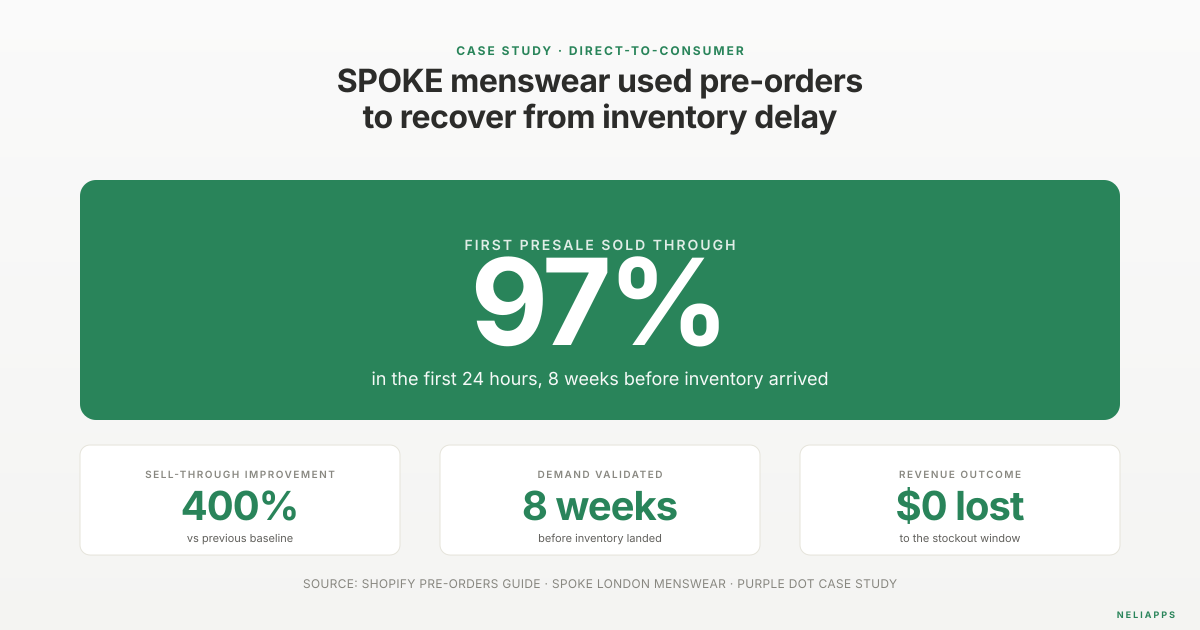
A real-world example comes from menswear brand SPOKE, who used pre-orders to recover demand during inventory delays. Their first presale sold through at 97% within 24 hours and delivered a 400% improvement on their previous pre-order sell-through baseline. Demand was validated and revenue was captured 8 weeks before inventory arrived, turning what would have been lost sales into a measurable conversion outcome.
Multi-product catalogs
Stores with 100 or more SKUs face a consistency problem at scale. Different product pages built at different times by different team members carry different trust signals, different review widgets, and different objection handling. The audit framework prioritizes standardization: one trust badge layout, one review component, one FAQ structure deployed across the catalog. This reduces the variability that compounds with SKU count and removes the per-product overhead of maintaining unique signal placement.
Subscription and recurring-purchase stores
Subscription Shopify stores monetize first-purchase conversion differently. The lifetime value of a converting visitor justifies heavier investment at the cart and checkout stages, where most subscription drop-off happens. The audit framework treats these stages with priority weighting against the lifetime metric, not the single-transaction metric, which shifts the install order toward NL Trust Badges and NL Announcement Bar earlier in the sequence.
Business Benefits of a Structured Conversion Audit
Predictable Stage-by-Stage Improvement
The most immediate benefit is replacing tactical guesswork with measured improvement. Stores can move conversion rate from 1.4% toward 2.0% within 90 days by sealing one leak per month, with each install measured in 14-day windows. Predictability replaces tactical churn.
Compounding Revenue Across Existing Traffic
Conversion improvements compound across every dollar of traffic the store already paid for. A store with $50,000 in monthly traffic value that lifts conversion from 1.4% to 1.8% unlocks an additional $14,000 per month without any change to ad spend or organic strategy.
Higher AOV Through Stage-Specific Optimization
AOV gains stack on top of conversion gains. Adding bundle suggestions at the cart stage typically lifts revenue by 5 to 15% (McKinsey personalization research) on the orders that do convert. Combined with conversion improvements at earlier stages, total revenue lift compounds beyond either metric alone.
Reduced Customer Acquisition Cost
Higher conversion rate divides the same paid acquisition spend by more orders, which directly lowers cost per acquisition. For Shopify stores spending heavily on Meta and Google ads, a 0.5% age point conversion lift can shift the business from break-even to profitable on the same budget.
Scalable Operations Without Headcount
The audit framework concentrates effort on the leak most worth sealing this month, rather than spreading effort across every page. This produces measurable lift without scaling team size, agency retainers, or development sprints, which makes the framework practical for stores at any stage from bootstrap to growth.
Risks and Governance Considerations
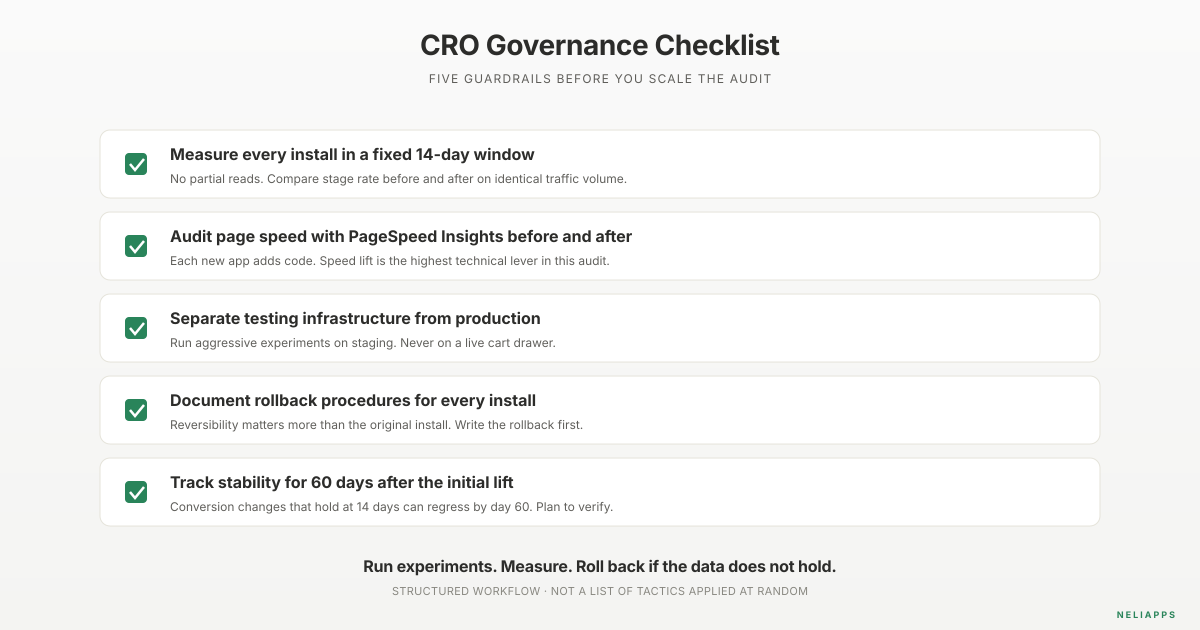
The biggest risk in CRO is treating individual hacks as final solutions. Conversion optimization works as a structured workflow, not as a list of tactics applied at random. Every install should be measured in a 14-day window before moving to the next leak, and every change should be reversible if the data does not support keeping it.
App proliferation is another consideration. Shopify stores often accumulate 20 or more apps over time, each adding code that affects page load. Page speed remains the highest-impact technical lever in any audit, and adding apps without measuring their performance impact can undo the conversion lift the apps were meant to deliver. Every app install should be paired with a PageSpeed Insights audit before and after.
Stores should also separate testing infrastructure from production when running aggressive CRO experiments. Conversion changes that look promising in 14 days may regress in 60 days, and rollback procedures matter more than the original install.
Best Practices for Implementing Conversion Optimization
Start With the Highest-Leverage Leak
The best starting point is the product page. It is where the gap between average and top performers is widest in Shopify (Littledata shows top stores converting at 7.5% add-to-cart versus the 4.6% average), and where the smallest investment produces the largest measurable lift. Reviews first, trust badges second, FAQ third, bundles fourth, pre-orders for the stockout edge cases.
Use Native Shopify Apps and Approved Integrations
CRO works best when the apps are built on Shopify's native stack. Apps that work natively with Shopify Checkout Extensibility avoid the performance penalty of legacy script-based solutions, and integrations that respect Shopify's data model produce more consistent measurement.
Measure Performance and ROI
Measurement is essential. Stores should track conversion rate per stage, add-to-cart rate, cart-to-checkout completion, AOV, and revenue per session. Without these metrics, CRO initiatives become guesswork. With them, operators can prove ROI per app installed and scale the audit framework with confidence.
Conclusion
The Shopify conversion audit is one of the most practical frameworks for stores looking to grow revenue without raising acquisition spend. It targets a real operational pain point: the gap between average and top-performing Shopify stores is wider than most operators realize, and the path to closing it sits in 5 specific stages.
The future of Shopify CRO is not chasing isolated tactics. It is running a structured audit, sealing one leak at a time, and measuring every change in 14-day windows. Stores that adopt this model early will compound their conversion improvements across every dollar of traffic they pay for.
About neliApps
For Shopify merchants exploring this shift, neliApps builds a catalog of native Shopify conversion apps covering every leak point in this audit framework.
Explore all neliApps conversion apps on the Shopify App Store, or learn more at neliapps.com.
neliapps.com · business@neliapps.com
.png)