.png)

TL;DR
- GEO (Generative Engine Optimization) is the practice of making your store and products visible inside AI-generated answers from tools like ChatGPT, Perplexity, and Google's AI features. The term comes from a Princeton-led research paper presented at KDD 2024, which showed the right optimizations can boost visibility in AI responses by up to 40%.
- The traffic is no longer hypothetical. Adobe Analytics, tracking over 1 trillion visits to US retail sites, measured AI-referred retail traffic up 693% year over year during the 2025 holiday season, and up more than 1,300% since it began tracking in October 2024. Semrush research found visitors arriving from AI search convert at 4.4 times the rate of traditional organic visitors.
- The window is asymmetric: AI answers name only a handful of products, so visibility is winner-take-most. Merchants whose catalogs AI systems can read, trust, and cite will absorb this channel. Merchants whose product data is thin or machine-unreadable will simply not exist in the answer.
Introduction
For twenty years, being found online meant one thing: ranking in a list of blue links. That model is being replaced in front of us. When a shopper asks ChatGPT for "the best running shoes under $100" or asks Perplexity to "find a gift for a ceramics lover," they don't get ten links. They get an answer, with a few specific products in it.
Either your product is in that answer or it isn't. There is no page two.
This is the problem GEO exists to solve, and the reason it matters now rather than someday is that every layer of the stack has already moved: the traffic (Adobe's retail data), the buyer quality (Semrush's conversion research), and the checkout itself (OpenAI and Stripe's Agentic Commerce Protocol, which lets shoppers buy from Shopify merchants without leaving the chat). This article explains what GEO is, shows the data from multiple independent sources, and ends with the concrete checklist a Shopify merchant can work through this month.
What is GEO? (And how it differs from SEO)
Generative Engine Optimization is the practice of optimizing your content and product data so that AI systems select, cite, and recommend it when they generate answers. The term was coined in the research paper "GEO: Generative Engine Optimization" by Aggarwal and colleagues from Princeton University and IIT Delhi, presented at ACM SIGKDD 2024. Testing nine content strategies across a benchmark of 10,000 real queries, the researchers demonstrated that GEO methods can boost a source's visibility in generative engine responses by up to 40%.
GEO is not a replacement for SEO. It is a different game played on top of it, with different rules:
.png)
The last row is the strategic opening for smaller merchants. Semrush's analysis of AI citation behavior found that ChatGPT frequently cites pages that rank far outside the top results for related queries, with almost 90% of citations coming from positions 21 or lower. AI engines are not simply reading Google's top 10 back to you. They select for usefulness and clarity, which resets a playing field that domain authority had frozen for a decade.
The data: this shift is already measurable
Skepticism is healthy, so here is the evidence from four independent organizations, none of which is quoting the other.
The traffic is real and compounding. Adobe Analytics, whose retail dataset covers more than 1 trillion visits to US retail sites, has watched AI referral traffic grow 14x since it began tracking the channel in October 2024, with the milestone numbers charted below. AI referrals are still small next to paid search or email, but no other retail channel is growing at anything like this rate.
The visitors are better, not just more numerous. Adobe's holiday data shows AI-referred shoppers bounce less, stay longer, and view more pages, and Semrush's June 2025 study of 500+ high-value topics found they convert at 4.4 times the rate of traditional organic visitors, because the AI has already done the comparison work before the click. Adobe's Prime Day 2026 data pushed the same direction, with AI-referred traffic converting 50.7% better than non-AI channels.
.png)
The behavior shift was predicted, and the prediction is aging well in the way that matters. Back in February 2024, Gartner predicted that traditional search engine volume would drop 25% by 2026 as AI chatbots absorb queries. As Gartner analyst Alan Antin put it:
"Generative AI solutions are becoming substitute answer engines."
Alan Antin, Vice President Analyst, Gartner (February 2024)
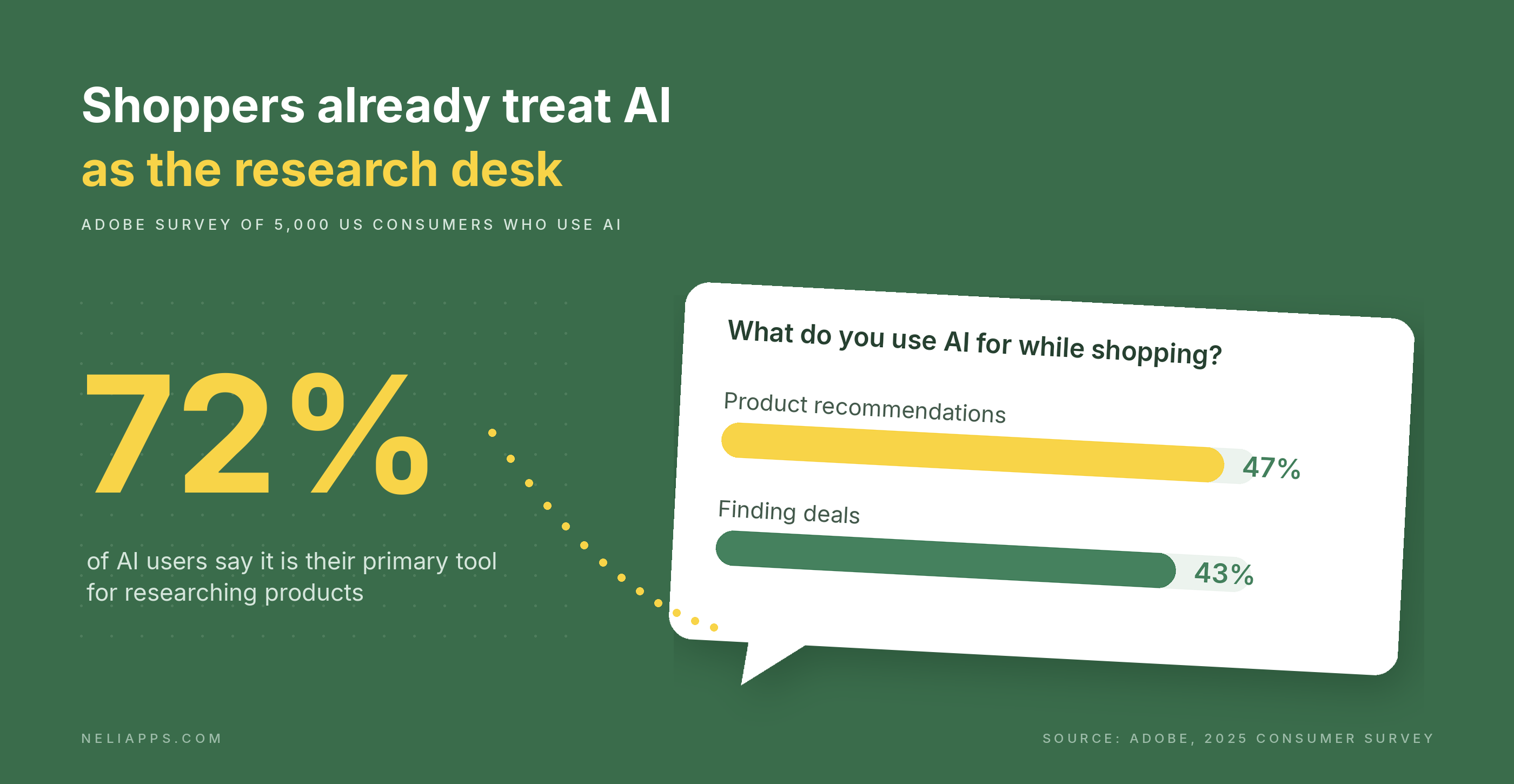
Two years on, the honest reading is nuanced: Google adapted with AI Overviews and still dominates raw search volume, so the headline number hasn't fully materialized. But the substitution Gartner described is exactly what Adobe's retail data captures. The queries that matter most to merchants, product research and recommendations, are precisely the ones moving into conversational tools, and Adobe's companion survey of 5,000 US consumers shows how far that behavior has already gone:
The checkout moved into the chat. In September 2025, OpenAI and Stripe launched Instant Checkout in ChatGPT on the open Agentic Commerce Protocol, and Shopify's agentic storefronts have since plugged eligible merchants straight into those rails:
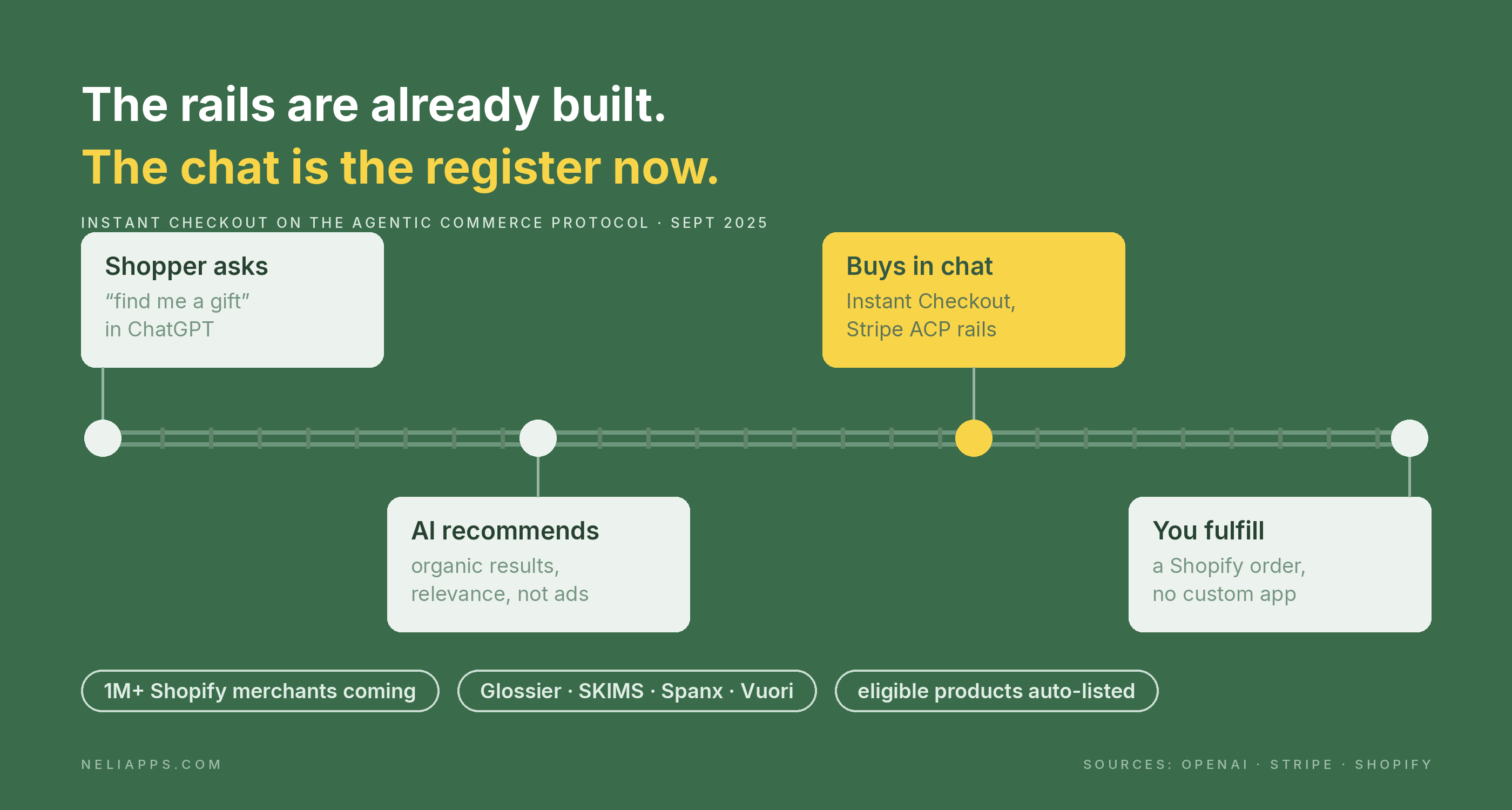
The rails are built. The only question left is whether AI systems can understand your catalog well enough to recommend it.
How AI engines decide which products to mention
This is where the Princeton research becomes a practical instruction manual rather than an academic curiosity. The paper tested nine optimization strategies and measured exactly which ones increased a source's share of AI answers:
- Adding specific statistics to content produced visibility gains in the 30 to 40% range on the study's position-adjusted metrics. Vague claims lose to precise numbers.
- Adding credible quotations performed comparably. Attributed statements from identifiable sources give the model something concrete to cite.
- Citing sources for claims lifted visibility as well. Content that references credible external evidence is itself treated as more citable.
- Improving fluency and readability produced gains of 15 to 30%, with no new information added. Clear prose is easier for a model to parse, summarize, and attribute.
- Keyword stuffing, the classic dark art of old SEO, performed worse than doing nothing at all in the study, scoring below the unmodified baseline.
.png)
Applied to a product catalog, the same logic that gets an article cited gets a product recommended:
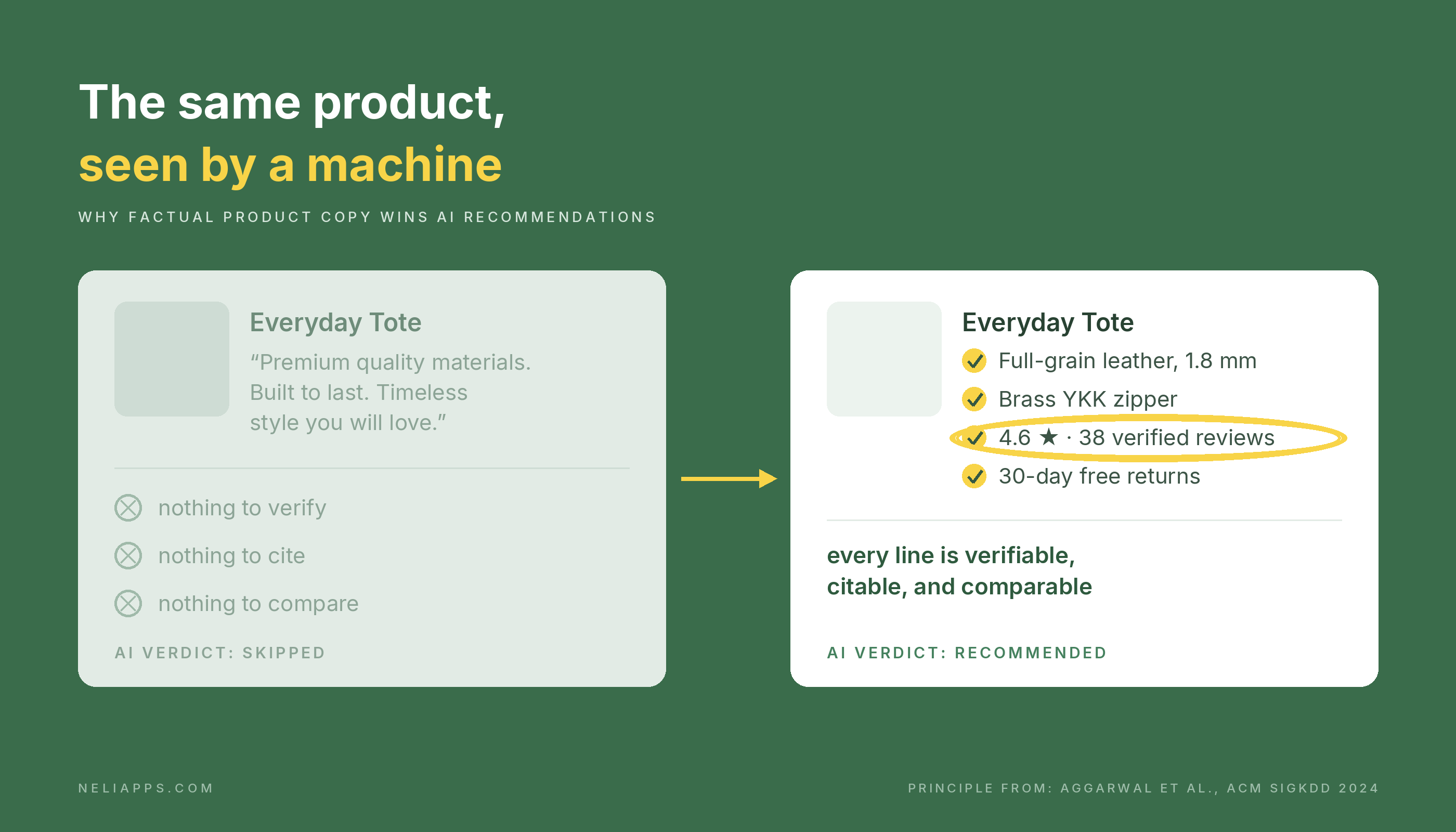
The GEO checklist for Shopify merchants
Everything above reduces to six moves. None requires an engineering team, and the first four are content and data work you control entirely.
.png)
One caution as you work the list: the Princeton finding on keyword stuffing generalizes. Attempts to game AI systems with repeated phrases, fake specificity, or manufactured reviews do not just fail, they score below doing nothing, and they poison the trust signals the rest of your GEO effort depends on. The entire discipline rewards the same thing your customers do: precise, honest, complete information.
Why "wait and see" is the expensive option
The economics of this channel punish late movers in a way traditional SEO never did.
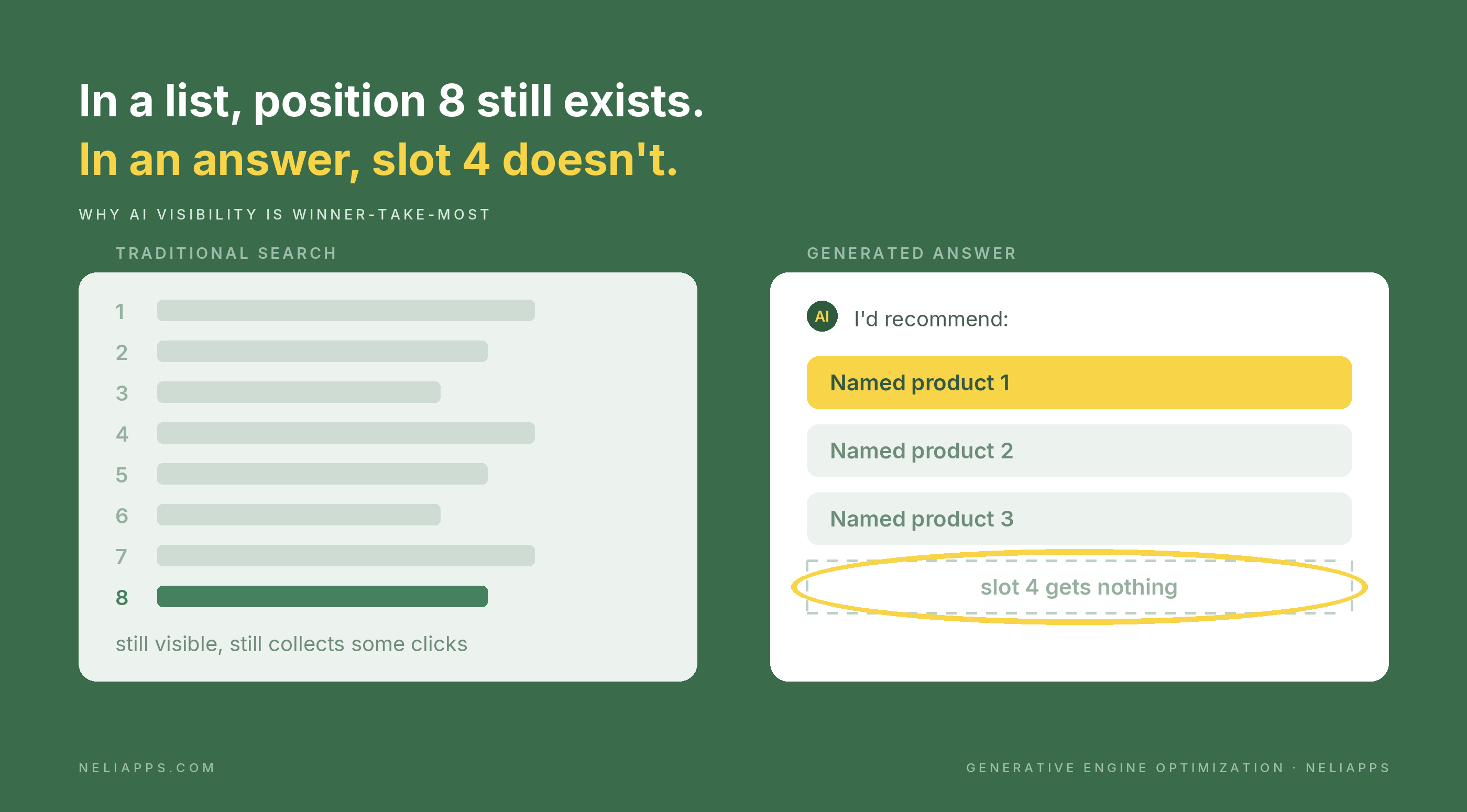
Winner-take-most distribution means the merchants who become AI systems' trusted, repeatedly-cited sources early will compound that advantage while the channel grows around them. Meanwhile the input costs are asymmetric too: your competitor's GEO work is mostly one-time data hygiene, and every month it sits in place, it accumulates citations, review volume, and referral history that a late starter has to catch up on while the leader keeps moving.
And unlike most emerging channels, this one arrives pre-monetized. With checkout living inside the chat through the Agentic Commerce Protocol, an AI recommendation is not an awareness impression that might convert someday. It is a purchase surface. Being absent from it is not a branding problem; it is a closed register.
FAQ
What does GEO stand for?
Generative Engine Optimization: the practice of optimizing content and product data to be selected, cited, and recommended by AI systems such as ChatGPT, Perplexity, and Google's AI features. The term was introduced in a Princeton-led research paper presented at the ACM SIGKDD conference in 2024.
Is GEO different from SEO, or just a rebrand?
Genuinely different. SEO competes for position in a ranked list of links; GEO competes for inclusion inside a single synthesized answer. The Princeton study found the tactics diverge sharply: adding statistics, quotations, and cited sources boosted AI visibility up to 40%, while keyword stuffing, a traditional SEO-era tactic, scored below the unmodified baseline. Strong SEO fundamentals still help AI systems find you, but they no longer decide whether you get recommended.
Is AI shopping traffic actually big enough to care about?
It is small in absolute share and extraordinary in trajectory and quality. Adobe Analytics measured AI referral traffic to US retail sites up 693% year over year in the 2025 holiday season and up over 1,300% since tracking began in October 2024, with those visitors bouncing less, staying longer, and, per Semrush's separate study, converting at 4.4 times the rate of organic search visitors. Channels rarely announce themselves more clearly than this before they mature.
Do I need to build anything technical to appear in ChatGPT shopping?
Less than you might think. Product results in ChatGPT are organic, and Shopify's agentic storefront infrastructure makes eligible merchants' products automatically available to AI platforms without a custom app. The technical rails exist; the merchant's job is the data flowing over them: complete product attributes, factual copy, visible reviews, and clear policies that AI systems can read and trust.
Can a small Shopify store realistically compete in AI answers?
More realistically than in traditional search, based on current citation behavior. Semrush found ChatGPT overwhelmingly cites pages ranking outside the top 20 traditional results, which means AI selection is driven by content usefulness rather than accumulated domain authority. A small store with precise, complete, verifiable product information can beat a large one with thin data.
Does GEO replace my SEO work?
No. Treat GEO as a layer on top: your store still needs to be crawlable, fast, and structured, which is SEO's job. GEO then determines whether, once found, your products are specific and trustworthy enough to be the ones an AI names. The overlap is convenient: almost everything on the GEO checklist (better product data, reviews, Q&A content, clear policies) also improves conversion for the human shoppers you already have.
Conclusion
GEO is not a prediction about the future; it is a description of infrastructure that already exists. The research defining it is peer-reviewed. The traffic is measured by Adobe across a trillion retail visits. The buyers convert at multiples of organic search according to Semrush. The checkout runs inside the chat on open rails built by OpenAI and Stripe, with over a million Shopify merchants in the pipeline. The only unbuilt piece is the one merchants control: a catalog that AI systems can read, verify, and confidently recommend. The stores that finish that work now will be the ones AI names by default. The stores that wait will be competing for the slots that are left, and in a generated answer, there are very few slots.
Get AI-ready with neliApps
This is exactly the problem NL Agent Ready was built for: it audits your product catalog the way an AI shopping agent reads it, scores every product from A+ to D, and generates the fixes, with one-click auto-fix, so ChatGPT, Perplexity, and Google AI can discover, understand, and recommend your products. Two other neliApps compound the effect: NL Product Reviews builds the verified review volume that gives AI answers citable proof, and NL FAQ Page generates the question-and-answer content that generative engines lift most easily into their responses. Every neliApp is built as a theme app extension, so none of it slows the store you are optimizing.
Install on Shopify now →
neliApps · neliapps.com · business@neliapps.com