.png)
TL;DR
- Reviews are not decoration; they are the highest-leverage content on your store. Northwestern University's Spiegel Research Center found that displaying reviews can lift conversion by up to 270%, that a product's first five reviews drive the bulk of that gain, and that the effect is roughly twice as large on higher-priced items.
- Most stores are short on reviews for one boring reason: they don't ask, or they ask at the wrong moment. PowerReviews' research across brands and retailers finds that up to 80% of all reviews originate from a single post-purchase email, and that nearly half of consumers now need a second reminder before they write one.
- Since October 21, 2024, collecting reviews the wrong way is not just tacky, it is illegal. The FTC's rule on consumer reviews bans fake and AI-generated reviews, buying positive reviews, and suppressing negative ones, with civil penalties of up to $51,744 per knowing violation. The good news: the compliant playbook and the effective playbook are the same playbook.
Introduction
Every Shopify merchant knows reviews matter. Far fewer know the actual numbers, and the numbers are stranger and more useful than the folklore.
The folklore says: get as many reviews as possible, chase five stars, and pester customers until they comply. The research says almost the opposite. The biggest conversion gains come from a handful of early reviews, not hundreds. A perfect 5.0 rating sells worse than a 4.5. And the single most effective collection tactic is not a popup, a widget, or a bribe; it is one well-timed email that most stores either never send or send at the wrong moment.
This article lays out the data-backed system: why the first five reviews matter most, exactly when to ask, how many times, what the FTC's 2024 rule now prohibits (with penalties large enough to end a small business), and why your negative reviews are quietly doing sales work for you. Every claim is sourced, and none of it requires annoying a single customer. The two goals turn out to be the same goal: the collection strategy that respects your customers is the one that produces the most reviews.
What reviews are actually worth (and how many you need)
The reference study here is Northwestern University's Spiegel Research Center analysis of over 100,000 SKUs across 22 product categories, and its findings set every target in this article.
The headline number: displaying reviews can increase conversion by up to 270%, meaning a product with five reviews has nearly four times the purchase likelihood of the same product with none. But the shape of the curve matters more than the peak:
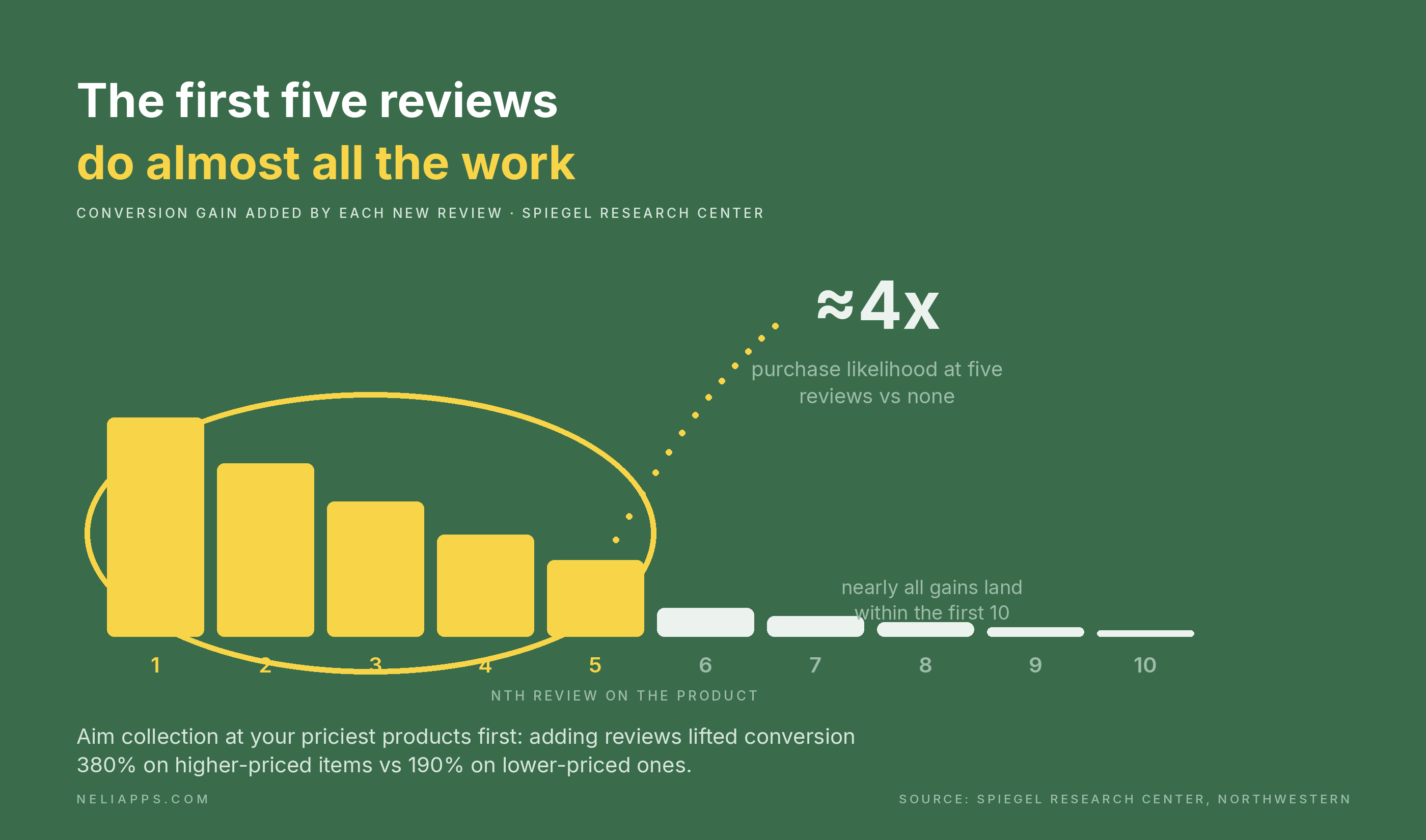
Two more findings sharpen where to aim the effort. The effect roughly doubles with price: adding reviews lifted conversion 190% on lower-priced products but 380% on higher-priced ones, so your most expensive products need reviews first. And reviews from verified buyers add another 15% to purchase likelihood over anonymous ones, which is why collecting through your own post-purchase flow (where every reviewer is a confirmed customer) beats any volume of unverifiable praise.
So the target is not "hundreds of reviews someday." It is five to ten verified reviews on every product that matters, starting with the expensive ones. That is a finishable project.
Why your customers aren't leaving reviews
It is almost never hostility. PowerReviews' survey research (6,500+ US consumers) finds that 99.9% of online shoppers read reviews at least sometimes and 98% consider them an essential purchase resource, and the same shoppers report being perfectly willing to write them: 92% say a great experience would motivate them to leave a review, and 72% cite the desire to help other shoppers.
The gap between willing customers and empty review sections comes down to four mechanical failures: nobody asked; the ask came before the product did; the form demanded a login, a title, and an essay; or the store quietly feared what customers might say. The rest of this article fixes each one.
Rule 1: Send the email. It is 80% of the game
If you do only one thing from this article, automate a post-purchase review request email. PowerReviews' data across its client base is blunt on this point:
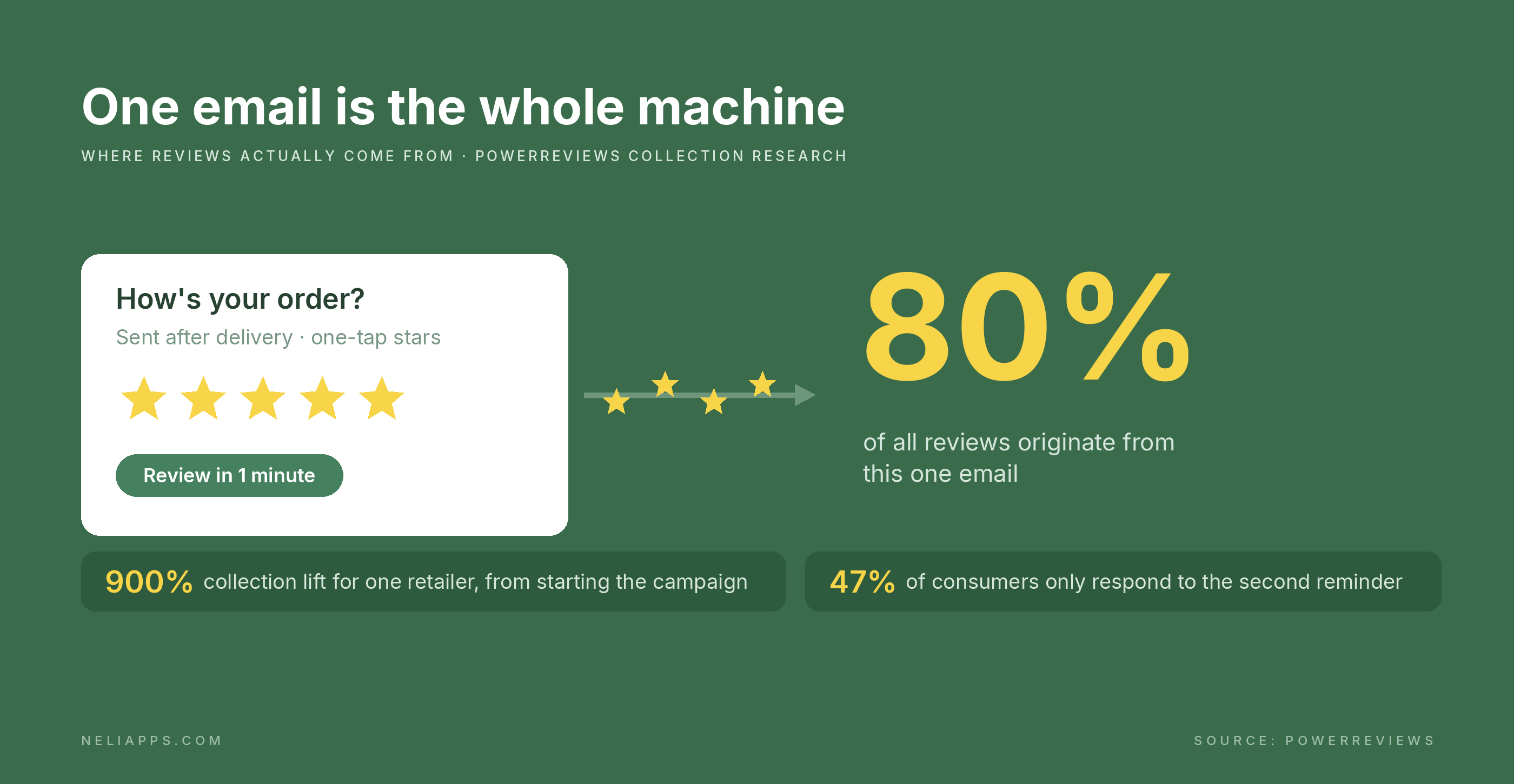
Nothing else on this list, no widget, no loyalty hook, no clever copy, comes close to the yield of simply asking every customer by email after their order arrives. One PowerReviews client grew review collection by 900% from starting the campaign alone. The email itself needs only three properties: a subject line that names the product, a body readable on a phone (where most email is opened), and one obvious tap target to start the review.
Rule 2: Time the ask to the product, not the purchase
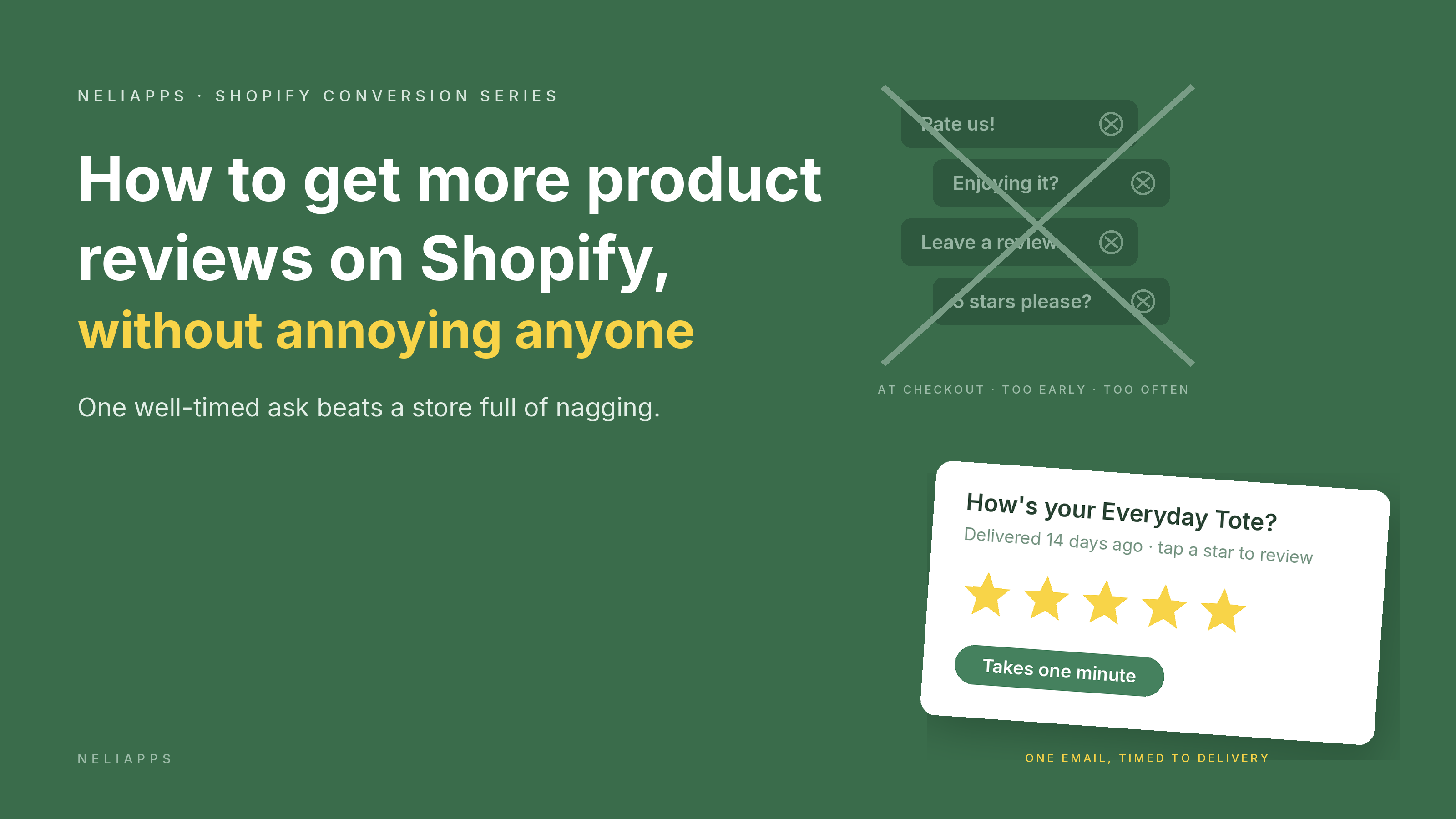
The fastest way to annoy a customer is asking for an opinion they cannot possibly have yet. A review request at checkout, or the day the box ships, reads as noise. The ask should land after delivery plus enough time to actually use the product, and "enough time" depends on what you sell:
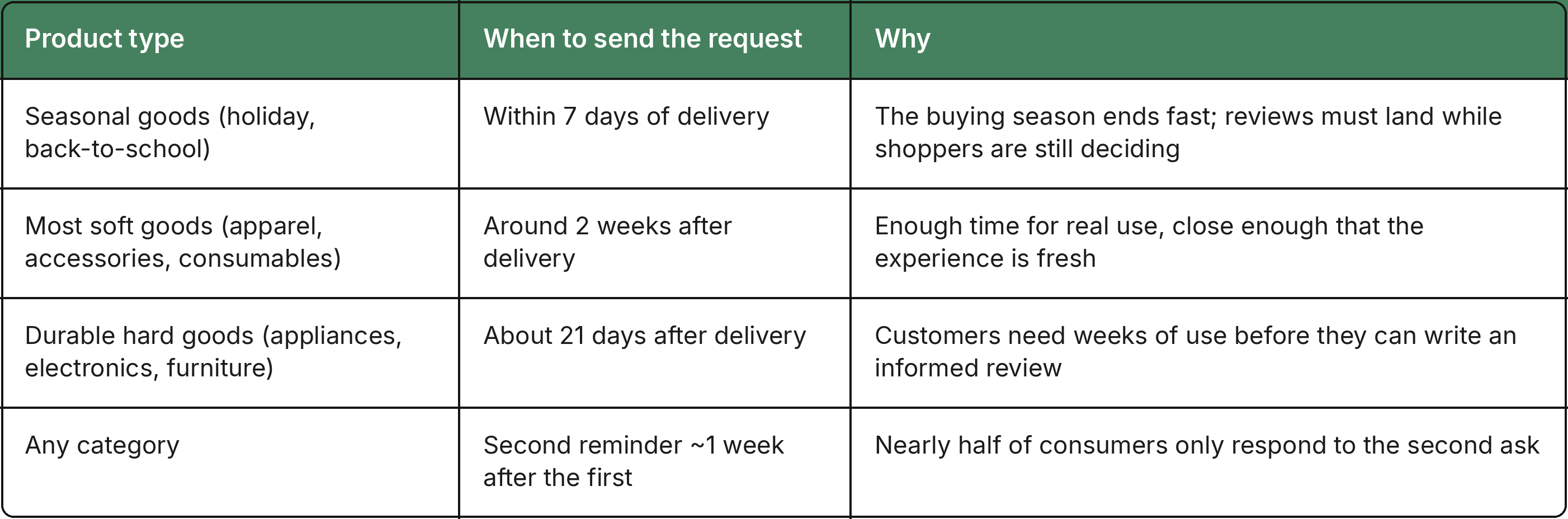
Timing windows above follow PowerReviews' published collection guidance. The principle underneath them travels to any catalog: the request should arrive at the moment the customer has the most to say.
Rule 3: Ask twice, and make answering nearly effortless
One email is no longer enough, and the data on this has moved fast. In PowerReviews' 2023 motivation survey, only 42% of consumers said a single ask gets them to write a review (down from 68% two years earlier), while 47% now need a second reminder, with younger shoppers needing follow-ups the most. Two emails is the new baseline; it is not pestering, it is how the majority of your willing reviewers actually respond.
The other half of this rule is friction. Every step between "I'll review it" and "submitted" sheds respondents: forced account login, mandatory review titles, minimum character counts, photo requirements. Let the star rating be one tap from the email itself, make text and photos optional, and let the whole thing finish on a phone in under a minute. You can always invite the enthusiastic minority to add photos afterward; you cannot recover the majority who closed a clunky form.
Rule 4: Know what the FTC now bans (and why it helps you)
On October 21, 2024, the FTC's Trade Regulation Rule on the Use of Consumer Reviews and Testimonials took effect, passed by a unanimous 5-0 vote, and it converted a set of shady growth hacks into federal violations carrying civil penalties of up to $51,744 per knowing violation. As FTC Chair Lina Khan put it, fake reviews
"pollute the marketplace and divert business away from honest competitors."
Lina M. Khan, FTC Chair, announcing the final rule (August 2024)
For a Shopify merchant, the practical lines are these:
AllowedBanned under the FTC ruleAsking every customer for an honest reviewWriting, buying, or AI-generating fake reviewsOffering an incentive for a review, disclosed, with no strings on sentimentPaying or incentivizing positive (or negative) reviewsOwner or staff reviews with the relationship clearly disclosedInsider reviews posing as ordinary customersDisplaying all qualifying reviews, high and lowSuppressing or hiding negative reviews to inflate the averageShowing real review counts and ratingsBuying followers, fake indicators of social proof
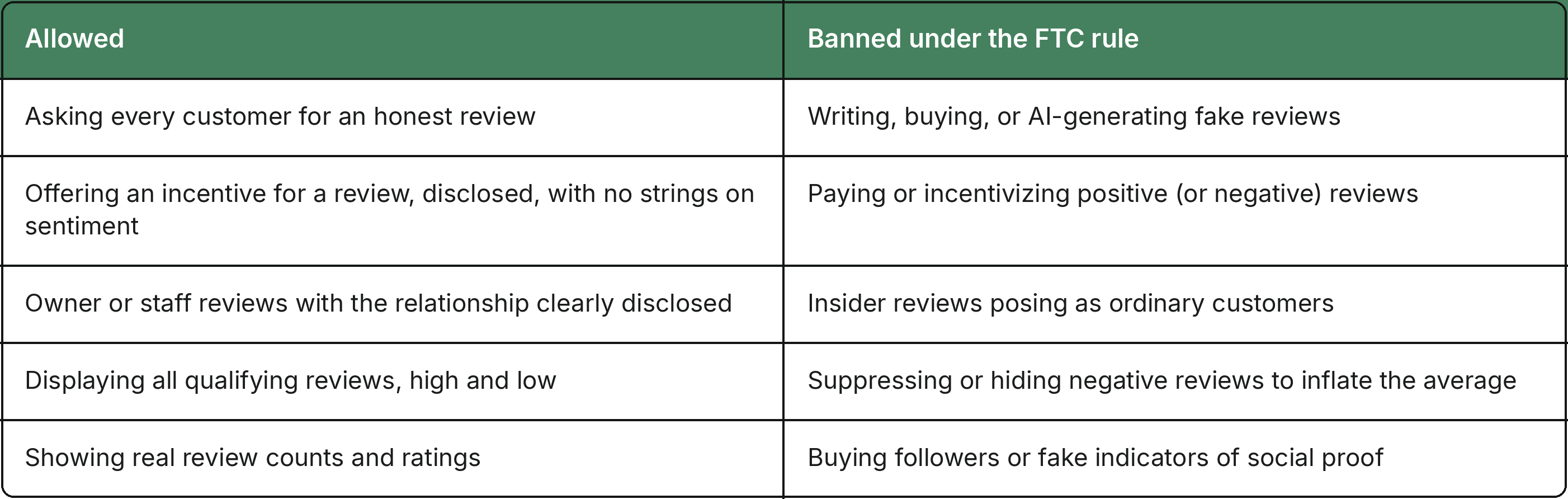
Read the banned column again and notice something: none of it collects reviews faster than the legitimate system in Rules 1 to 3. The rule did not outlaw effective tactics; it outlawed shortcuts that were already poisoning shopper trust. Merchants running an honest post-purchase flow lose nothing and gain a marketplace where their real reviews compete against fewer fakes.
Rule 5: Keep the negatives. They are selling for you
The instinct to fear (or worse, bury) critical reviews runs into two of the most counterintuitive findings in the Spiegel research.
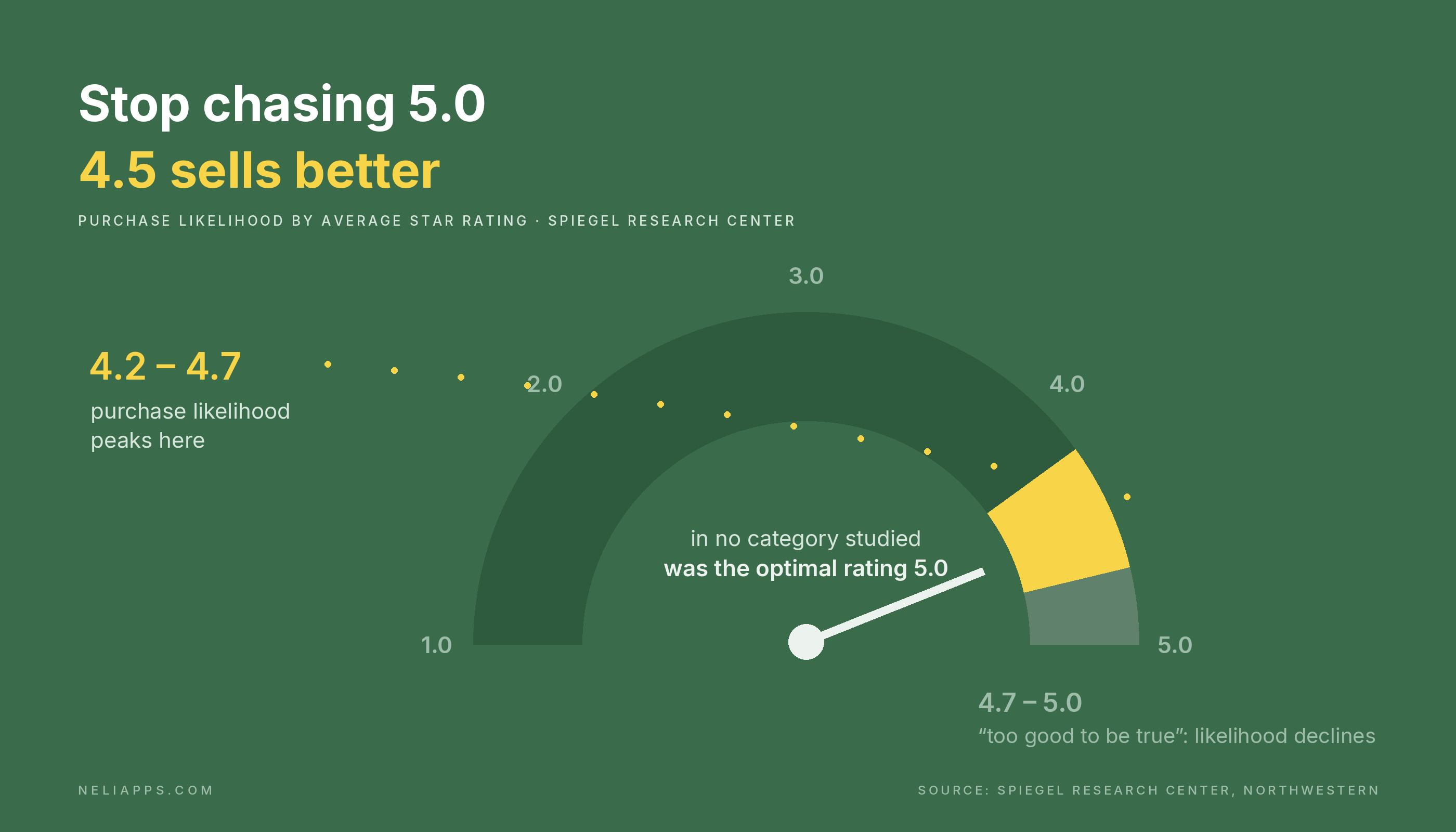
First, the sweet spot: purchase likelihood peaks at average ratings between 4.0 and 4.7 and then declines as ratings approach a perfect 5.0. Products rated 4.7 to 5.0 sell worse than products rated 4.2 to 4.7, because a flawless score reads as "too good to be true." In no product category the researchers studied was the optimal rating 5.0.
Second, engagement with criticism converts. Shoppers who interact with negative reviews spend four times as long on site and convert at a 67% higher rate, because the negatives answer the question every buyer is silently asking: what is the catch? A visible two-star review about sizing, next to a calm merchant reply offering the fix, does more objection-handling than any banner you could write.
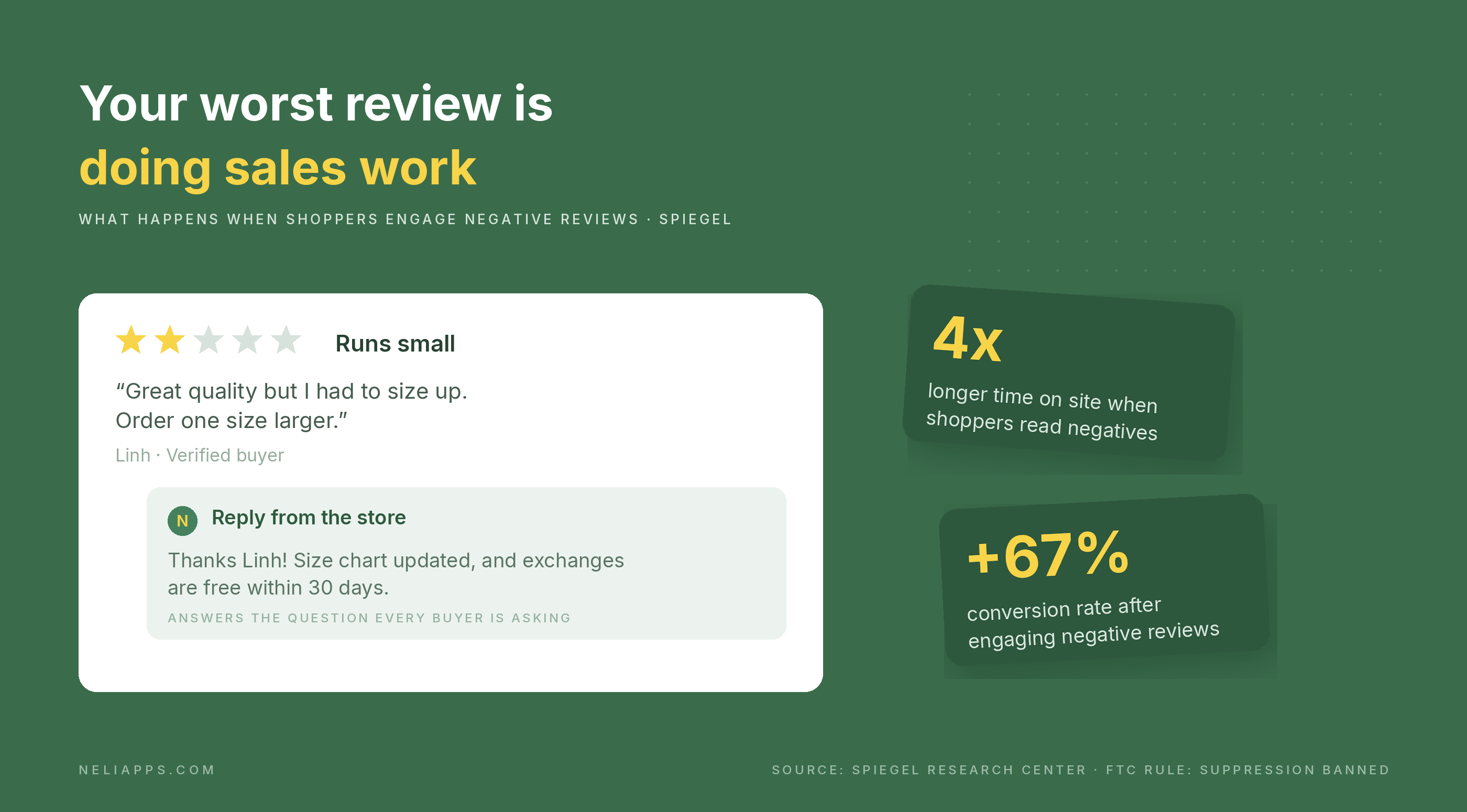
So the policy writes itself: publish qualifying negatives (the FTC now requires it anyway), reply to them quickly and specifically, and stop chasing 5.0. A 4.5 with a few honest complaints is not a blemish on your store. It is the most believable ad you have.
Your review system in one checklist
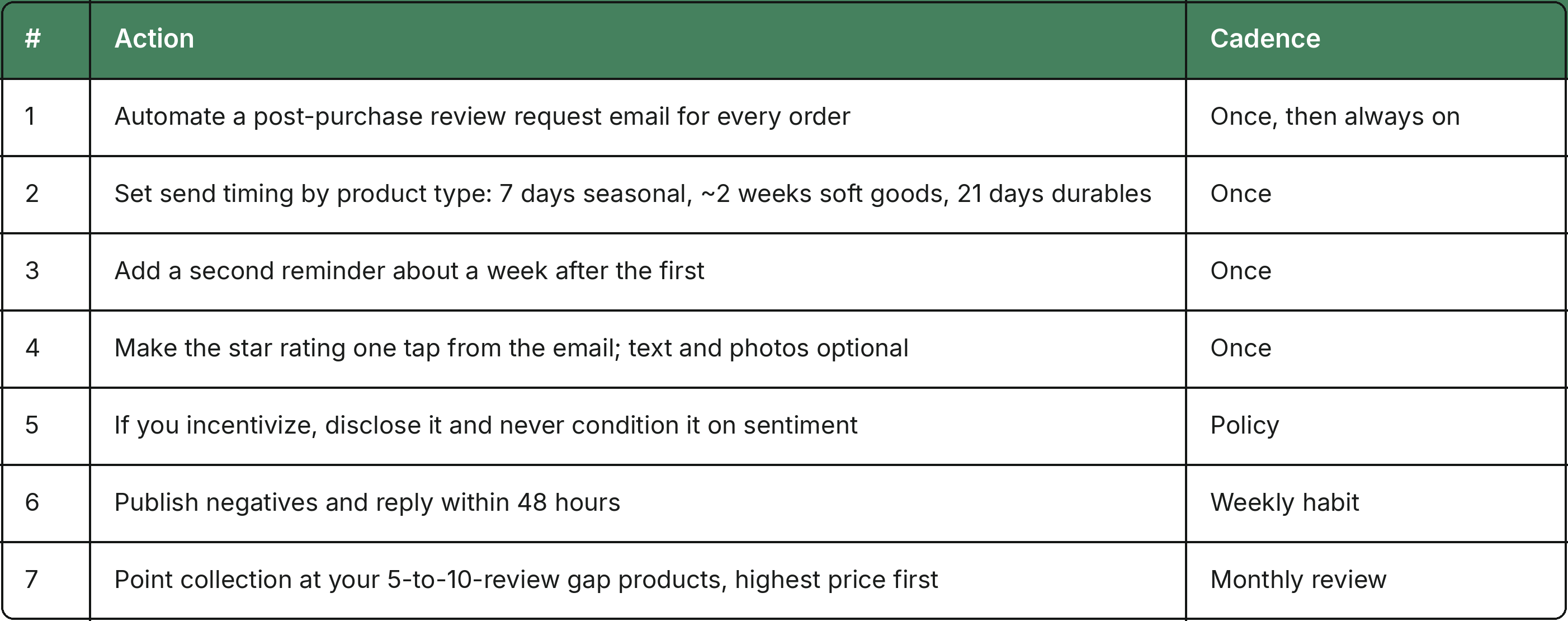
FAQ
How many reviews does a product need before reviews start working?
Five is the number that moves the needle. The Spiegel Research Center found a product with five reviews has nearly four times the purchase likelihood of one with none, the first five reviews drive the bulk of the total gain, and nearly all of it arrives within the first ten. Aim for five to ten verified reviews per product before optimizing anything else.
When is the best time to send a review request email on Shopify?
After delivery plus enough time to use the product: within 7 days for seasonal goods, around 2 weeks for most soft goods and consumables, and about 21 days for durable hard goods, following PowerReviews' collection guidance. Never ask at checkout or on the ship date, because the customer has nothing to review yet.
Is it legal to offer a discount for leaving a review?
Yes, with two conditions that became federal law in October 2024: the incentive must be disclosed, and it cannot be conditioned on the review being positive. Offering "10% off your next order for an honest review" is fine; offering anything for a five-star review risks FTC civil penalties of up to $51,744 per knowing violation.
Should I delete or hide negative reviews?
No, on both commercial and legal grounds. The FTC's 2024 rule treats suppressing negative reviews to inflate your average as a violation. And the Spiegel data shows shoppers who engage with negative reviews convert at a 67% higher rate, while average ratings in the 4.2 to 4.7 range outsell perfect 5.0s. Reply to negatives instead of removing them.
Do review request emails annoy customers?
Not when they are timed to the product and capped sensibly. PowerReviews finds up to 80% of all reviews come from post-purchase emails, 92% of consumers say a great experience motivates them to review, and nearly half only respond to a second reminder. Two well-timed emails per order is the evidence-backed norm; daily popups and guilt-trip banners are where annoyance actually lives.
Do reviews help with AI shopping tools like ChatGPT?
Yes, and increasingly so. Ratings and review counts are exactly the kind of specific, verifiable data AI shopping tools cite when recommending products, which is why review volume now feeds a second discovery channel beyond your product page. We cover that shift in our guide to generative engine optimization for Shopify.
Conclusion
The review problem is smaller than it looks. You do not need thousands of reviews; you need five to ten per product, verified, starting with your most expensive items. You do not need aggressive tactics; you need one automated email, sent when the customer has actually used the product, with a reminder a week later and a form that takes a minute on a phone. You do not need a perfect score; 4.5 with honest negatives outsells 5.0. And as of October 2024, you do not even need to out-hustle the fakers, because the FTC turned their shortcuts into liabilities. The merchants who quietly run this system for one quarter wake up with the most persuasive content on their store written for free, by the only authors shoppers actually believe.
Collect reviews the right way with neliApps
NL Product Reviews runs this entire system on your store: automated post-purchase requests with per-product timing, one-tap star ratings that work on any phone, verified-buyer badges on every published review, and moderation that keeps you on the right side of the FTC rule without hiding honest criticism. Pair it with NL Trust Badges so the social proof your reviews build is reinforced with security reassurance at the payment step, the combination our store trust deep-dive shows works best, and see how reviews close the number-three cause of abandonment in our cart abandonment guide. Like every neliApp, it is built as a theme app extension, so it adds proof to your store without slowing it down.
Install on Shopify now →
neliApps · neliapps.com · business@neliapps.com
.png)