
.png)
TL;DR
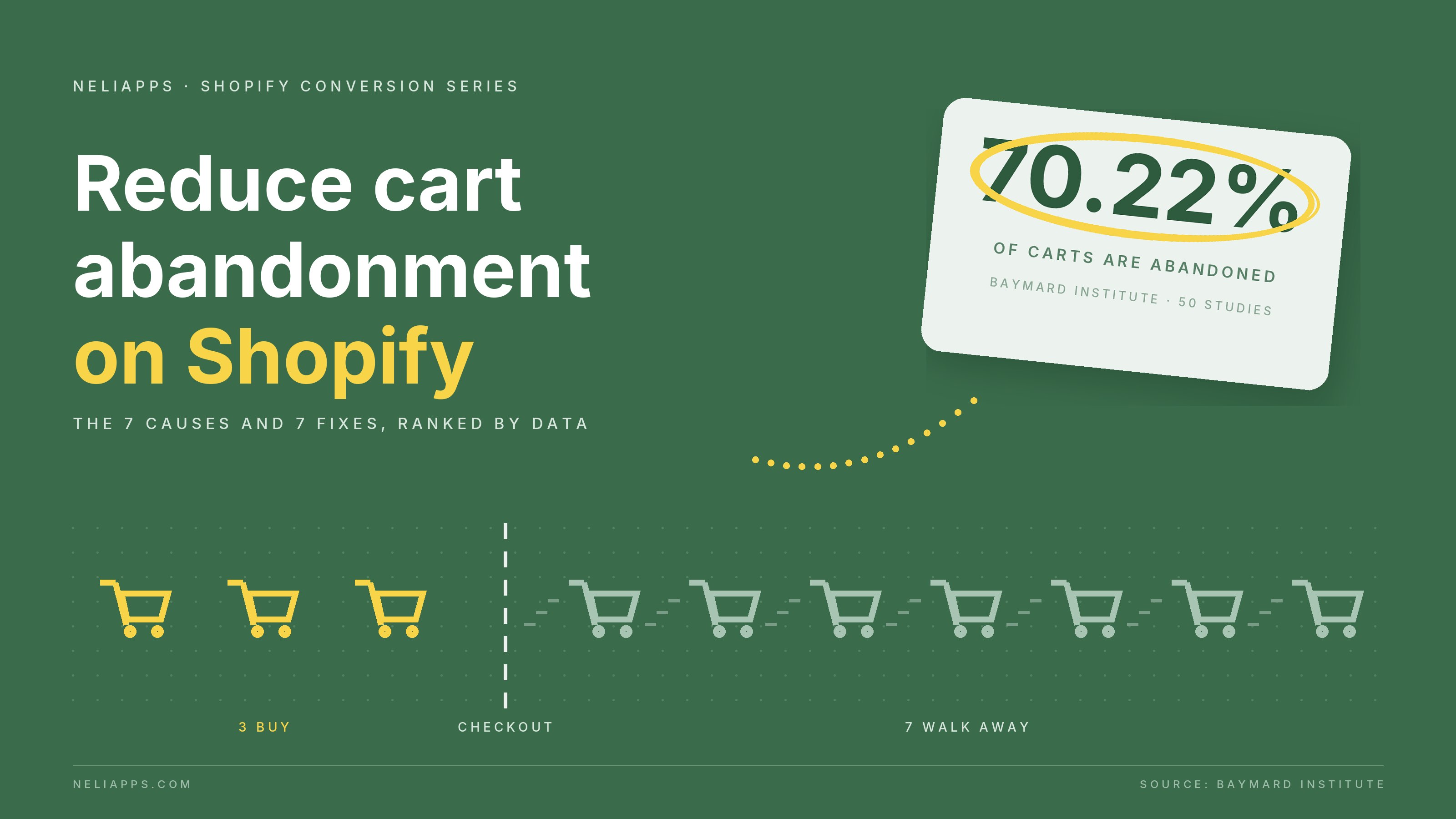
- The average documented cart abandonment rate is 70.22%, calculated by Baymard Institute across 50 separate studies. Roughly 7 out of every 10 shoppers who add a product to a cart leave without buying.
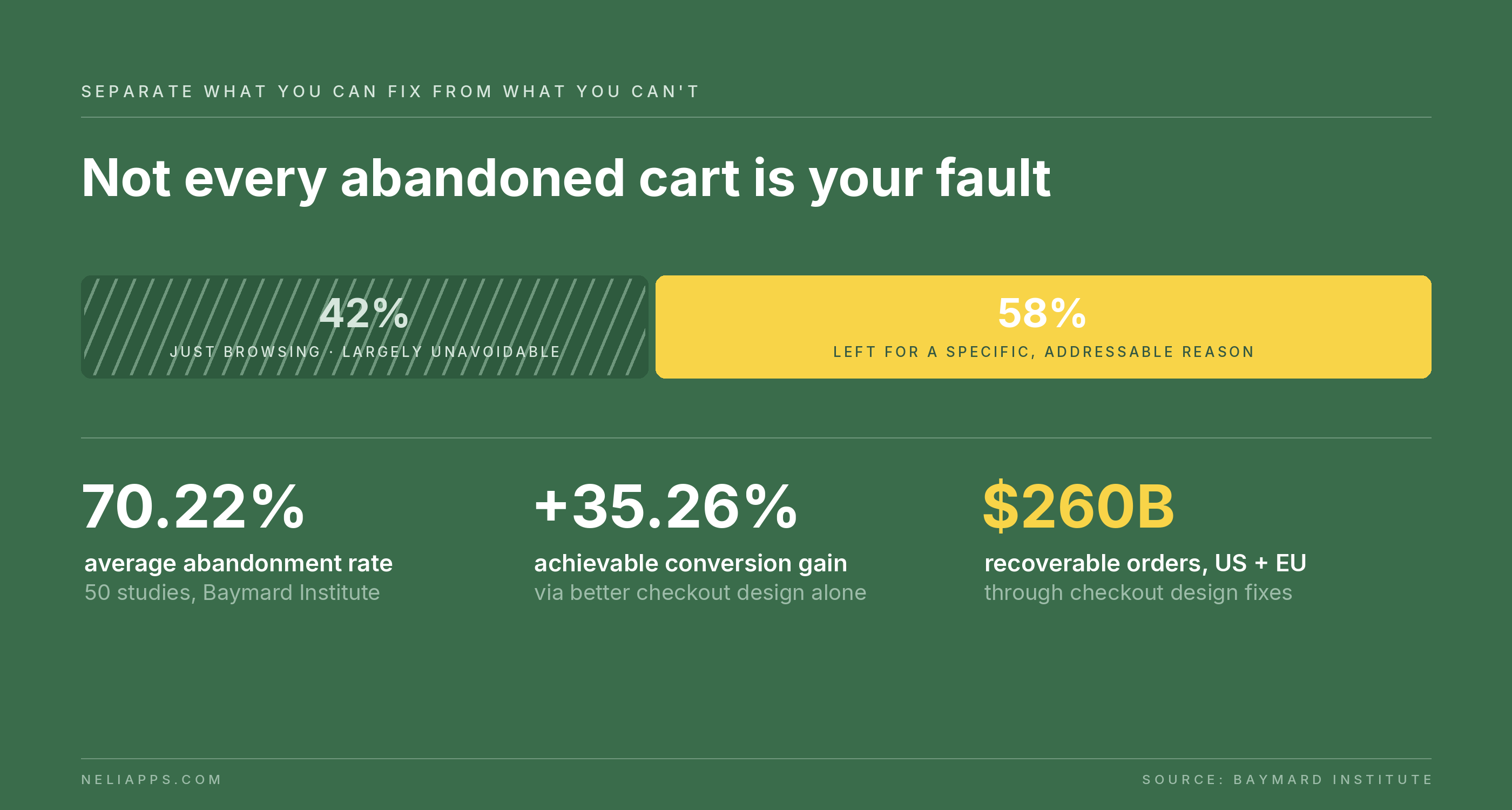
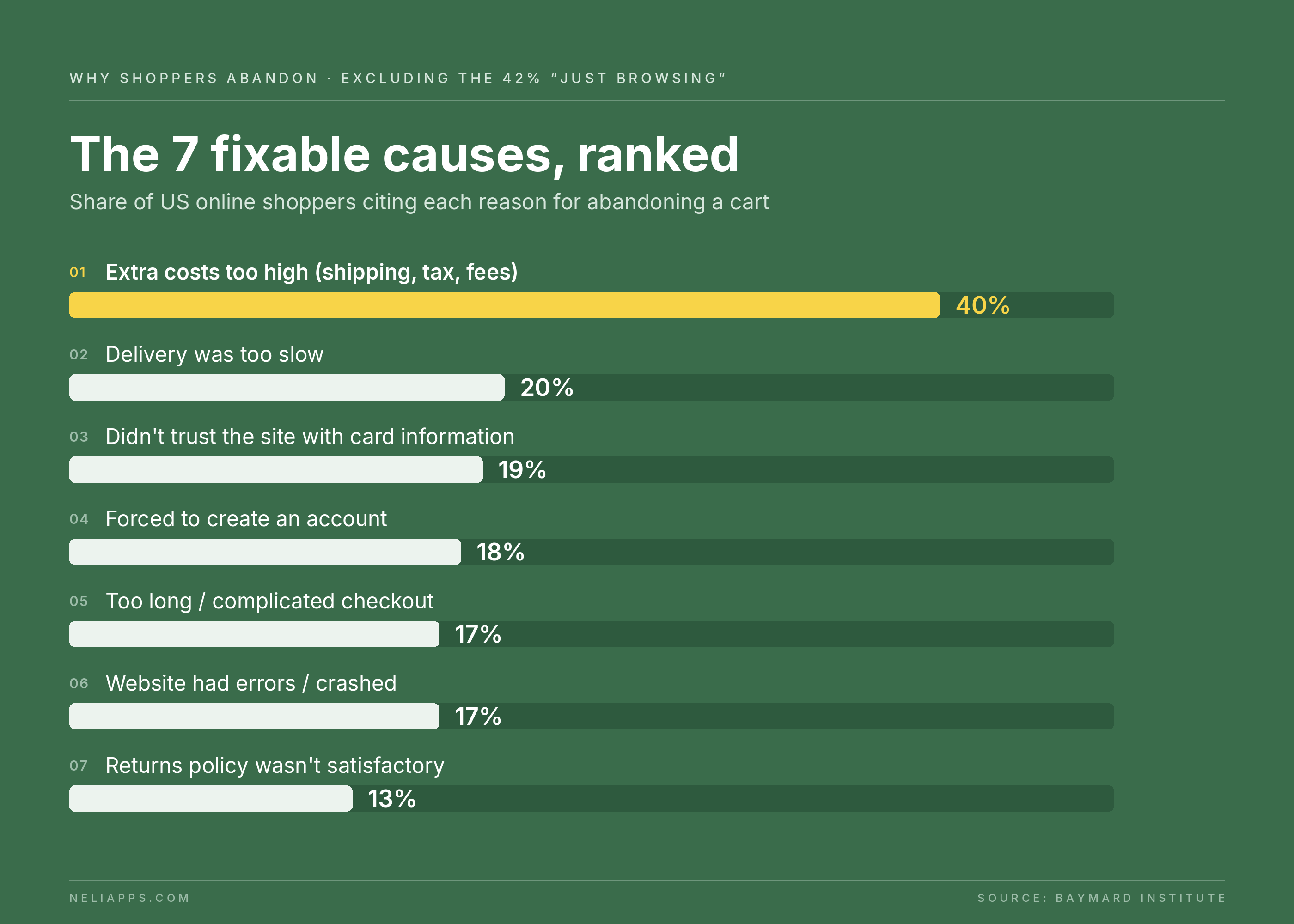
- Not all of it is fixable. 42% of US online shoppers have abandoned a cart simply because they were browsing. But among shoppers who left for an actionable reason, the causes rank clearly: extra costs (40%), slow delivery (20%), payment distrust (19%), forced account creation (18%), long checkout (17%), site errors (17%), and a weak returns policy (13%).
- Every one of those seven causes has a documented fix, and none of them is a discount. Baymard estimates the average large ecommerce site can gain a 35.26% increase in conversion rate through better checkout design alone, roughly $260 billion in recoverable orders across the US and EU.
Introduction
Cart abandonment is the most expensive gap in ecommerce and also the most misunderstood one. The headline number is grim: Baymard Institute, which has aggregated 50 different studies of shopping cart abandonment, puts the average documented rate at 70.22%. Seven of every ten shoppers who show enough intent to place a product in a cart walk away before paying.
The misunderstanding is treating that 70% as a single problem. It is not. A large share of abandonment is simply how people shop online, as Baymard puts it, much of it is
"A natural consequence of how users browse ecommerce sites."
No checkout redesign recovers a shopper who never intended to purchase today. What the data does hand you is the other half: shoppers who wanted to buy and were stopped by something on your site. Baymard's survey ranks those actionable reasons precisely, and that ranking is the roadmap for this article, the seven causes in order of how many shoppers they cost you, each paired with the fix the research supports. None of them requires a discount.
What is a normal cart abandonment rate, and how to calculate yours
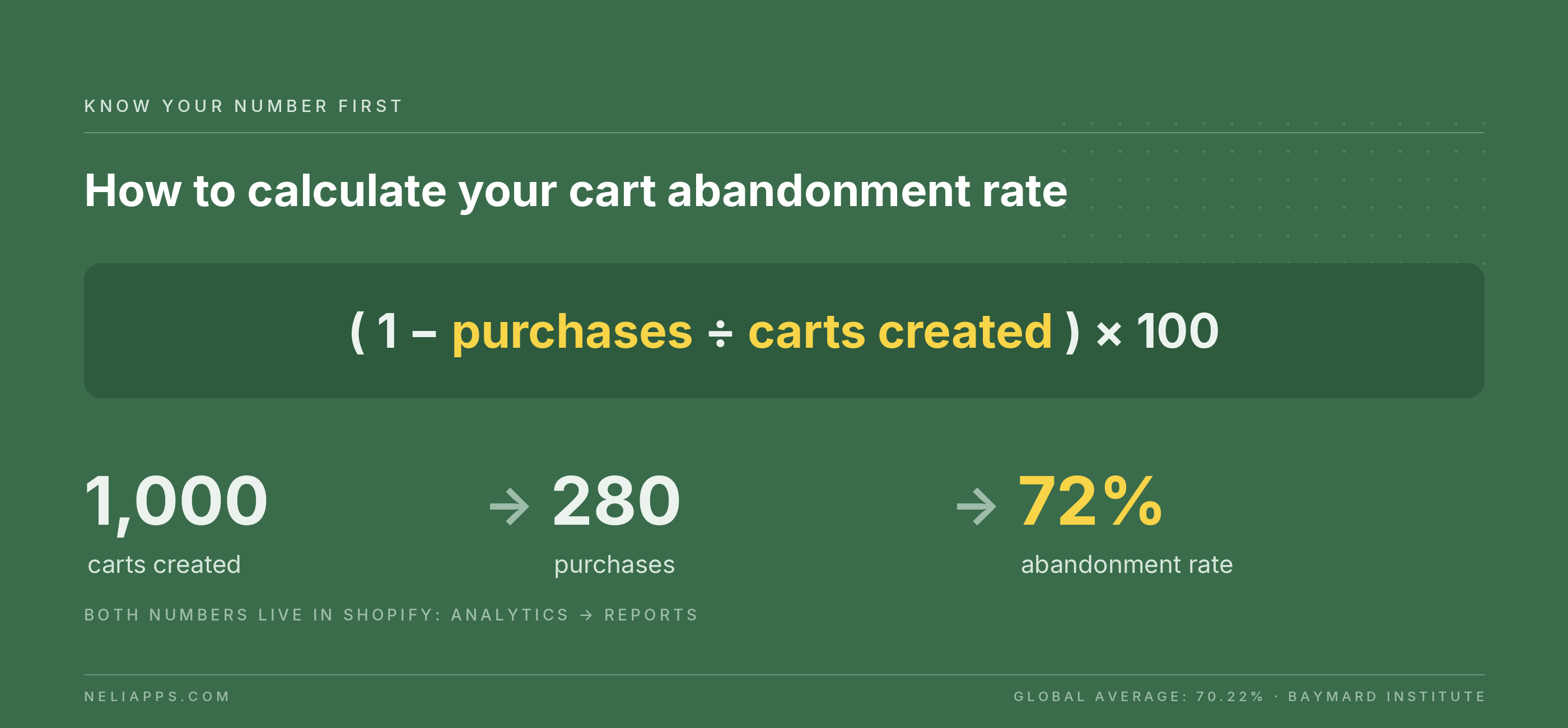
Before fixing anything, know your own number. The formula:
Cart abandonment rate = ( 1 − completed purchases ÷ carts created ) × 100
On Shopify, pull both numbers from Analytics → Reports: "Sessions that added to cart" and "Sessions that completed checkout" over the same date range. If 1,000 sessions added to cart and 280 purchased, your abandonment rate is 1 − (280 ÷ 1,000) = 72%.
Then separate what you can influence from what you cannot. Baymard's 70.22% average is a meta-figure drawn from 50 studies whose individual results range from roughly 55% to 84%, depending on year, industry, and methodology. Within that, the 42% "just browsing" segment is largely unavoidable: window shopping, price comparison, saving items for later, and exploring gift options are natural behaviors, not failures of your store.
Set the browsing segment aside and the remaining reasons, the ones shoppers themselves cite, distribute as follows in Baymard's survey:
The payoff for working this list is not theoretical. Focusing only on checkout usability issues Baymard has documented as solvable over a decade of large-scale testing, the average large ecommerce site can gain a 35.26% increase in conversion rate through better checkout design. Against combined US and EU ecommerce sales, that translates to about $260 billion worth of recoverable orders.
Diagnose your store first: which cause is costing you the most?
Baymard's ranking is the industry average; your store's ranking may differ. Before working the list top to bottom, spend 30 minutes matching your own analytics symptoms to the likely cause:
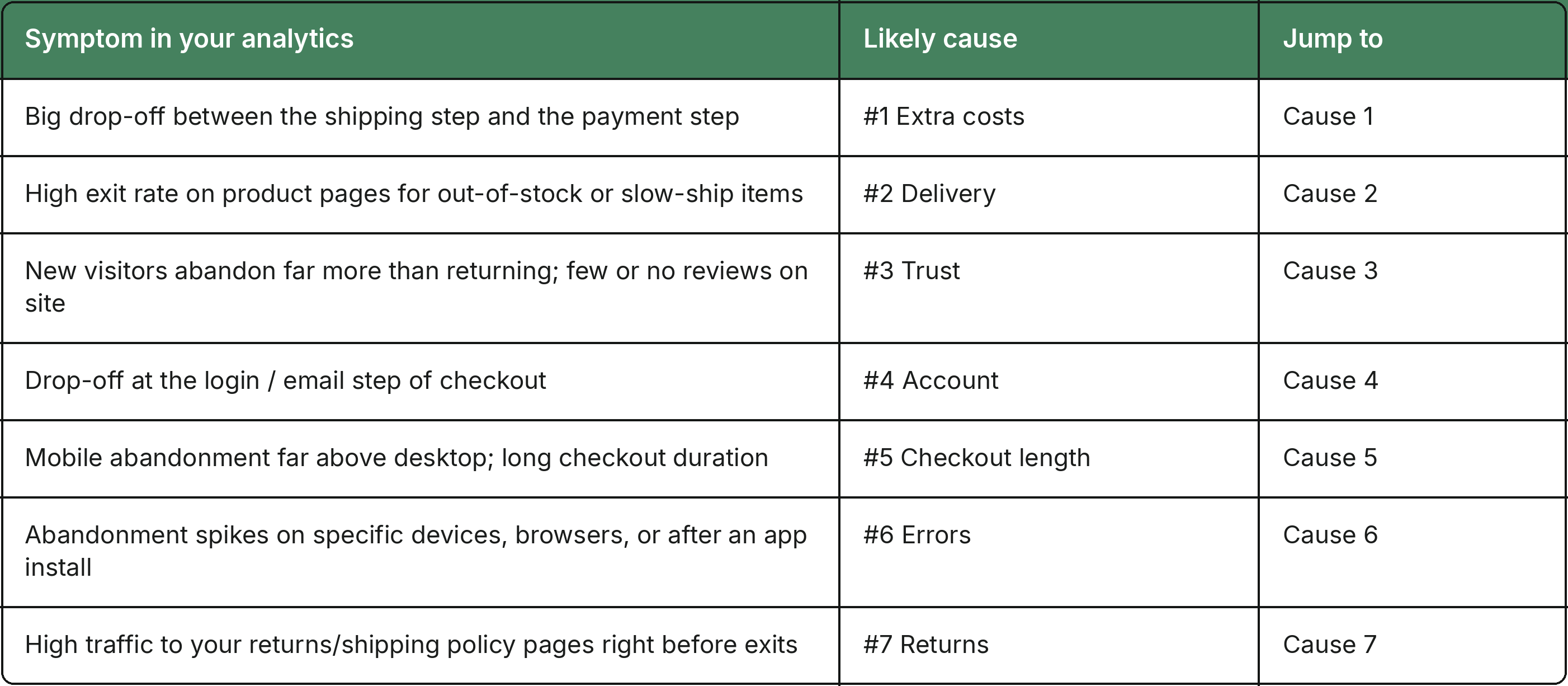
If nothing stands out, work the causes in ranked order, the sequence below is sorted by how many shoppers each one costs on average.
Cause 1: Extra costs too high (40% of abandoning shoppers)
Unexpected shipping fees, taxes, and surcharges at checkout are the single largest fixable cause of cart abandonment, cited by 40% of shoppers in Baymard's survey. The mechanism is a broken promise: the shopper committed to a price on the product page, and the checkout quietly changed the deal. A related failure sits just below the top seven: 12% of shoppers abandoned because they couldn't see or calculate the total order cost up-front. Both are the same wound: cost surprise.
Fix 1: Kill the surprise, then reframe the cost as a goal
The first half of the fix is transparency. Show shipping costs and any fees as early as possible, ideally estimated on the cart page rather than revealed at the final step. A shopper who knows the full price before checkout cannot be ambushed by it.
The second half turns your biggest liability into your best merchandising tool: the free shipping threshold. Instead of surprising shoppers with a fee, show them how to avoid it. The behavioral research here is well established. Kivetz, Urminsky, and Zheng's "The Goal-Gradient Hypothesis Resurrected" (Journal of Marketing Research, 2006) demonstrated that people accelerate their effort as they approach a reward, which is exactly what a visible "you're $12 away from free shipping" message taps into. Make the threshold impossible to miss: a sitewide announcement bar states the goal before the shopper ever builds a cart, and progress messaging in the cart counts down the remaining amount.
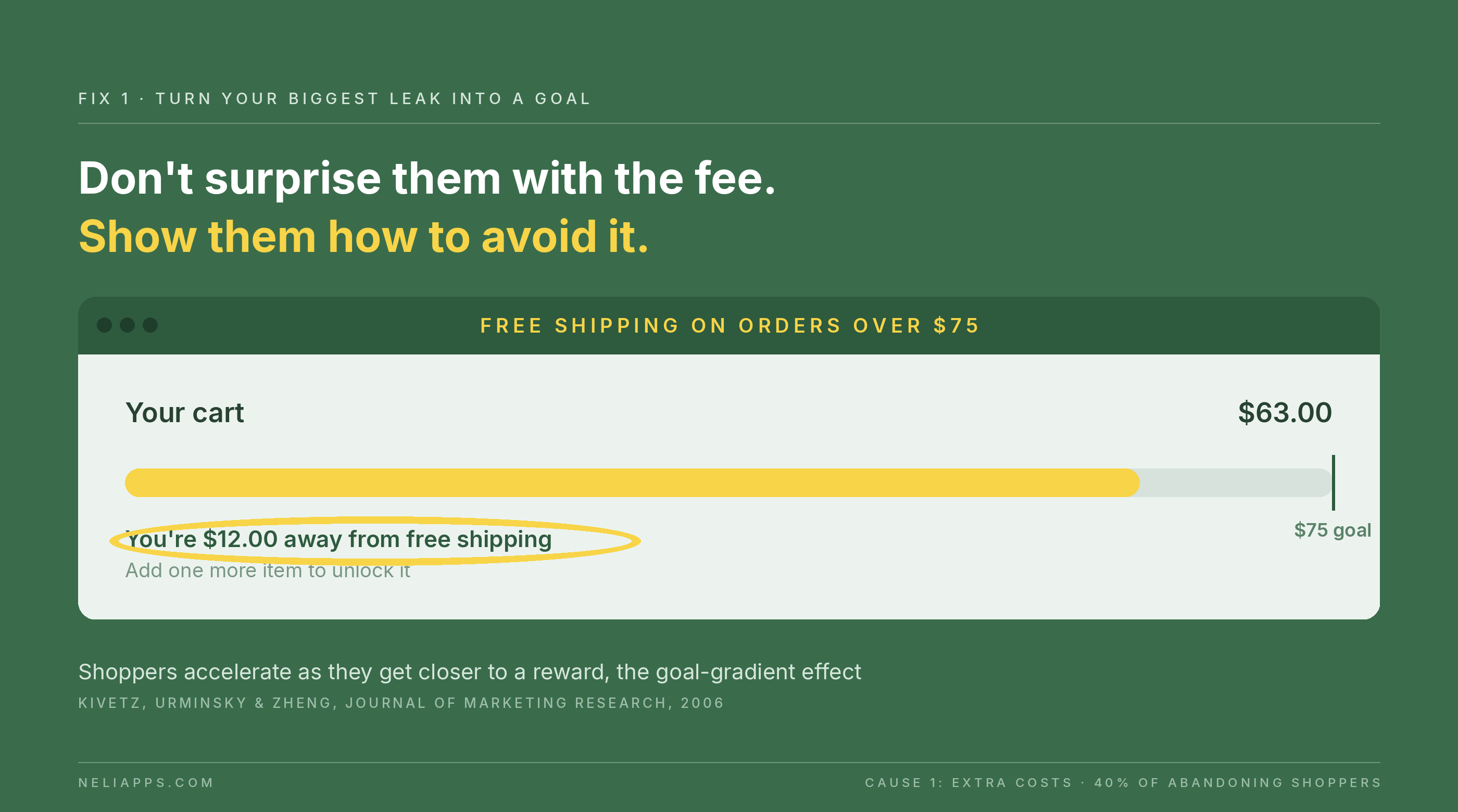
A well-set threshold doesn't just prevent abandonment. It also raises basket size, which is why it's also the most reliable lever in our guide to increasing average order value without discounts.
Cause 2: Delivery was too slow (20%)
One in five shoppers who abandoned for a fixable reason did so because delivery was too slow. Speed matters, but notice what the survey actually measures: the shopper's judgment at checkout, made with whatever information you gave them. Vague or absent delivery dates get read pessimistically.
Fix 2: Sell the date, not just the speed
You cannot always ship faster, but you can almost always communicate better. Show a concrete delivery estimate ("arrives Tuesday, Aug 18") rather than an abstract range ("5–9 business days"), and surface it on the product page and in the cart, not only at the last checkout step. If you offer an expedited option, price it clearly next to the standard one so the shopper chooses their trade-off instead of abandoning over it.
There's also a special case worth planning for: when the honest answer is "not soon" because the item is out of stock or not yet released. That shopper doesn't have to be lost. A back-in-stock alert converts "unavailable now" into captured intent you can act on the day inventory returns, and a pre-order converts a future ship date into a committed sale today. Both replace a silent abandonment with an explicit, dated promise.
Cause 3: Didn't trust the site with credit card information (19%)
Nearly one in five abandoning shoppers cited distrust of the site with their card details. For lesser-known brands this is the tax on being unfamiliar, and it spikes precisely at the payment step, where perceived risk is highest.
Fix 3: Layer proof and reassurance where doubt peaks
Baymard's research on this is specific: perceived security is largely a gut feeling driven by how secure a page looks, and visual security cues, meaning site seals and badges placed near the payment fields, measurably raise that perceived security, with the effect strongest for brands shoppers don't already know.
Reassurance works best on a foundation of proof, and the strongest proof is other customers. Northwestern University's Spiegel Research Center found that a product page with five reviews has a 270% higher purchase likelihood than a page with none, with the first handful of reviews driving the largest jump and the effect strongest on higher-priced items. A store that shows verified reviews on the product page and a recognizable security badge beside the card fields has answered both questions a nervous shopper is silently asking:
Is the product real, and is my card safe?
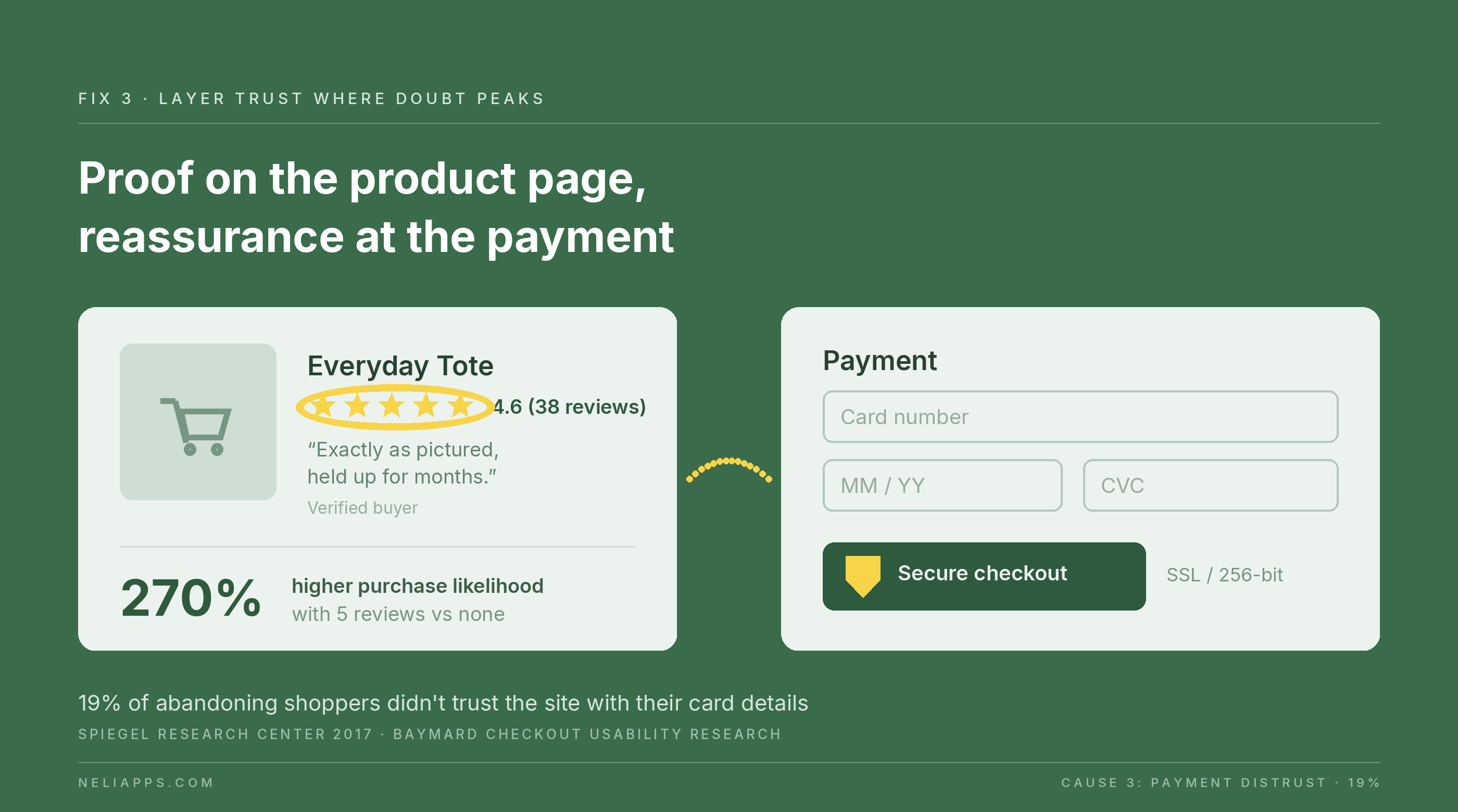
We broke down the full evidence hierarchy, why reviews outrank badges and both outrank your own copy, in why shoppers don't trust your Shopify store.
Cause 4: Forced account creation (18%)
18% of shoppers have abandoned because the site wanted them to create an account. From the shopper's side the math is simple: they came to buy a product, and you inserted a relationship they didn't ask for, plus a password they'll forget, between them and the purchase.
Fix 4: Guest checkout by default, account afterward
Guest checkout should be prominent, not a small link under the login form. On Shopify this is a settings decision, not a development project: set customer accounts to optional in Settings → Checkout so no shopper is ever forced to register to pay.
The elegant part is that you lose almost nothing. You collect the email address during checkout anyway, and the post-purchase page is a far better moment to offer an account ("save your details for next time") than a pre-purchase gate.
Cause 5: Too long / complicated checkout (17%)
17% of shoppers have abandoned an order because the checkout process was too long or complicated. Baymard quantifies exactly how much bloat is typical: the average US checkout flow displays 23.48 form elements to shoppers by default, while their large-scale usability testing shows an ideal checkout can be as short as 12 to 14 form elements. Most checkouts can cut the number of elements shown by 20 to 60%.

Fix 5: Cut fields, then let express checkout skip them entirely
Shopify merchants start from a strong baseline, because Shopify's checkout is standardized and already streamlined. The remaining wins are removing every optional field you don't truly need (company name, second address line shown by default) and enabling express payments.
Express checkout is the most powerful single lever. Shopify's study of its 10,000 largest merchants found that checkouts completed through Shop Pay had a 1.72x higher checkout-to-order rate than regular checkouts, rising to 1.91x on mobile, where typing is slowest and patience shortest. An external study by a major management consulting firm similarly found Shop Pay lifts conversion by up to 50% relative to guest checkout. Accelerated wallets like Shop Pay, Apple Pay, Google Pay, and PayPal turn your 23-field problem into a one-tap answer, and offering several of them also addresses the 9% of shoppers Baymard finds abandoning because there weren't enough payment methods.
Cause 6: Website had errors / crashed (17%)
Just as many shoppers, 17%, abandoned because the website had errors or crashed. This cause is invisible in the average merchant's mental model because you rarely see your own store fail. It fails on someone else's older phone, on a slow connection, during a traffic spike, or after an app conflict silently broke a script.
Fix 6: Treat performance and stability as conversion features
Three habits cover most of the risk:
- Test the full purchase path on real mobile devices regularly, not just on the desktop where everything always works.
- Audit your app stack. Apps that inject code into your theme are a classic source of conflicts and slow pages. Apps built as theme app extensions (Shopify's sandboxed integration model) load independently of your theme and survive theme updates.
- Run one live test order after every theme change or app install. Five minutes of testing catches the crash before 17% of your buyers do.
Cause 7: Returns policy wasn't satisfactory (13%)
13% of abandoning shoppers left because the returns policy wasn't satisfactory, and an unknowable number more left because they couldn't find the policy at all. A missing returns answer reads as a bad returns answer.
Fix 7: Answer the objection before it's asked
The returns policy belongs where the buying decision happens: linked or summarized on the product page and visible in checkout, not buried in the footer. State the window, the condition requirements, and who pays return shipping in plain language.
The same logic extends to every other quiet objection: sizing, materials, shipping times, warranty. A well-organized FAQ absorbs the questions that would otherwise send a shopper away "to think about it," which in practice often means to abandon. Shoppers who leave your site to find an answer rarely come back with the cart intact.
Your 7-fix action checklist
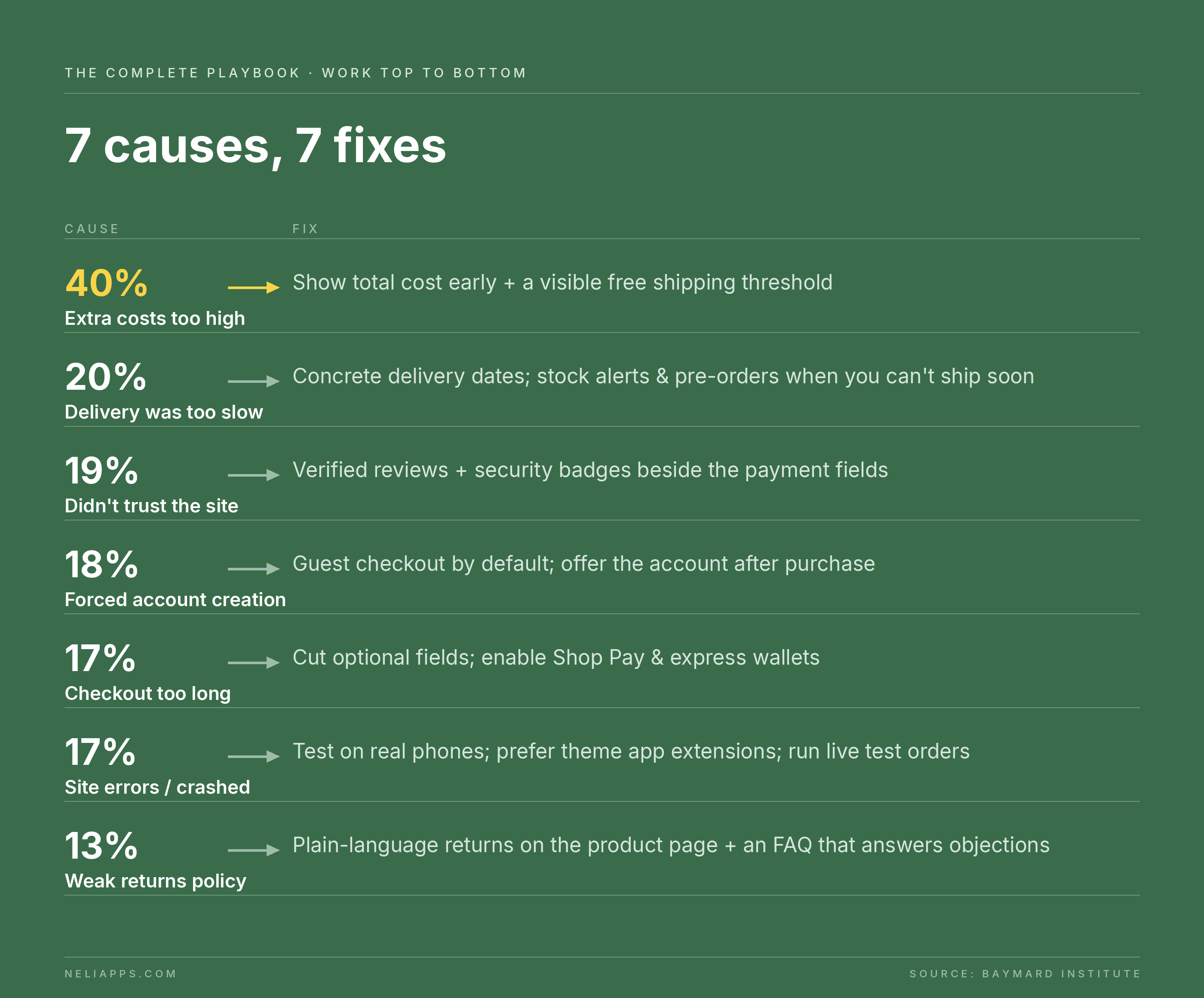
Work top to bottom. The list is sorted by how many shoppers each cause costs on average:
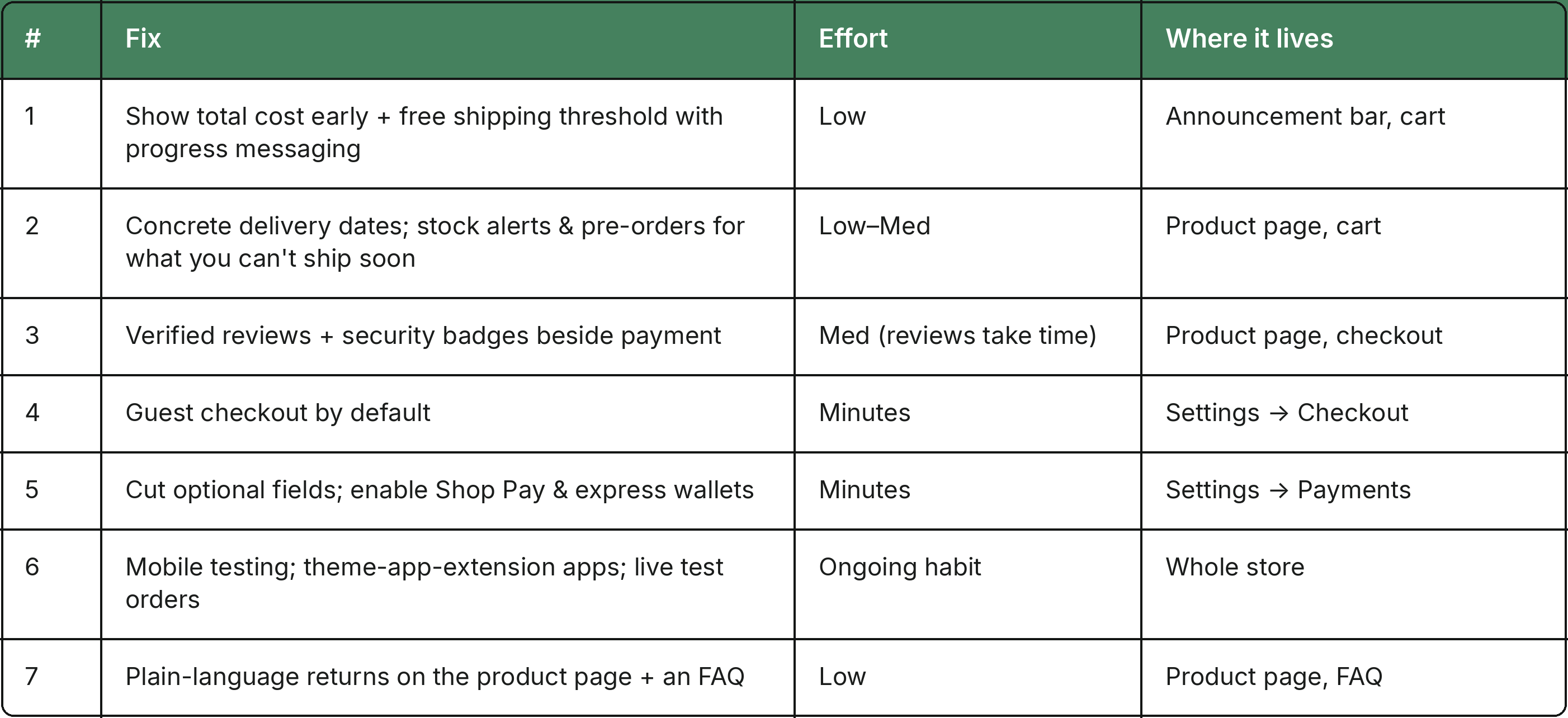
Change one thing at a time and watch checkout completion rate, not just traffic, so you can attribute the gain. And note what this list deliberately omits: discounts and aggressive exit popups. The seven causes are friction and doubt, not price. A coupon can paper over a trust problem for one order while training shoppers to abandon carts on purpose to fish for codes. Fixing the underlying cause compounds; the coupon doesn't. (For where cart fixes fit in the bigger funnel picture, see our 5-stage Shopify conversion audit)
FAQ
What is the average cart abandonment rate?
70.22%, according to Baymard Institute's running average across 50 separate studies of ecommerce cart abandonment. Individual studies in that dataset range from roughly 55% to 84% depending on year and methodology, so treat your own trend over time as more meaningful than any single benchmark.
How do I calculate my cart abandonment rate on Shopify?
Divide completed checkouts by sessions that added to cart over the same period, subtract from 1, and multiply by 100. Both numbers are in Shopify under Analytics → Reports. Example: 280 purchases from 1,000 add-to-cart sessions = 72% abandonment.
What is the number one reason shoppers abandon carts?
Among shoppers who abandoned for an actionable reason (excluding the 42% who were just browsing), extra costs such as shipping, taxes, and fees rank first at 40% in Baymard's survey. It has consistently been the leading fixable cause.
Can cart abandonment ever reach zero?
No, and chasing zero is the wrong goal. Baymard finds 42% of shoppers have abandoned simply because they were browsing or not ready to buy, which is natural shopping behavior. The realistic target is eliminating the seven fixable causes, which Baymard's research suggests is worth up to a 35.26% conversion rate improvement for the average large site.
Do I need to offer free shipping to fix the extra-costs problem?
Not unconditionally. The two components of the fix are transparency (show total costs early so there is no surprise) and a free shipping threshold (a minimum order value that unlocks free delivery). The threshold converts the shipping fee from a surprise into a goal, supported by goal-gradient research showing shoppers accelerate as they near a reward, and it protects your margin better than blanket free shipping.
Is a complicated checkout really costing me sales on Shopify?
Shopify's checkout is already streamlined, but the data says friction still matters: 17% of shoppers have abandoned over a long or complicated checkout, and Shopify's own study of its 10,000 largest merchants found Shop Pay express checkout produced a 1.72x higher checkout-to-order rate than regular checkout (1.91x on mobile). Enabling express payment options is the highest-leverage checkout change available to most merchants.
Are abandoned cart recovery emails enough?
Recovery emails help, but they are triage, not treatment. They reach the shopper after the friction already won. The seven fixes in this article are prevention: they stop the abandonment from happening, which is why Baymard frames the $260 billion opportunity around better checkout design rather than better follow-up.
Conclusion
Cart abandonment looks like one giant leak, but the research shows it is seven small, specific ones, each with a known size and a known fix. Cost surprises, vague delivery promises, missing trust signals, forced accounts, bloated forms, silent errors, and unanswered returns questions: every one is a decision you can change this quarter without touching your prices. The stores that treat Baymard's ranked list as a to-do list, starting from the 40% cause and working down, are the ones that claim their share of the $260 billion the research says is sitting on the table.
Work with the neliApps conversion apps
Several of the neliApps conversion apps map directly onto the fixes above. NL Announcement Bar puts your free shipping threshold in front of every visitor sitewide, turning the number-one abandonment cause into a basket-building goal. NL Trust Badges places security reassurance exactly where Baymard's research says doubt peaks, right beside the payment moment, and NL Product Reviews builds the social proof foundation that makes an unfamiliar store feel safe to buy from. NL FAQ Page answers the returns, shipping, and sizing objections that quietly end 13% of purchases, and when you can't deliver soon, NL Stock Alert and NL Pre-Orders capture the demand you'd otherwise lose to a slow date. Every neliApp is built as a theme app extension, so they load independently of your theme with no impact on store speed, which matters when site errors are themselves a top-seven abandonment cause.
Install on Shopify now →
neliApps · neliapps.com · business@neliapps.com
.png)