
.png)
.png)
TL;DR
- Trust is no longer a soft factor. Edelman's 2025 research found that trust has become a purchase consideration on par with cost and quality, and the strongest trust signal you can place on a product page is an authentic customer review.
- The evidence points to a clear hierarchy: real customer reviews outperform trust badges, and both outperform your own marketing copy, because shoppers discount what a seller says about itself.
- Layer your signals, keep them honest, and lift the review snippet above the fold, because the research shows the first handful of reviews drives the largest single jump in conversion.
The Trust Gap
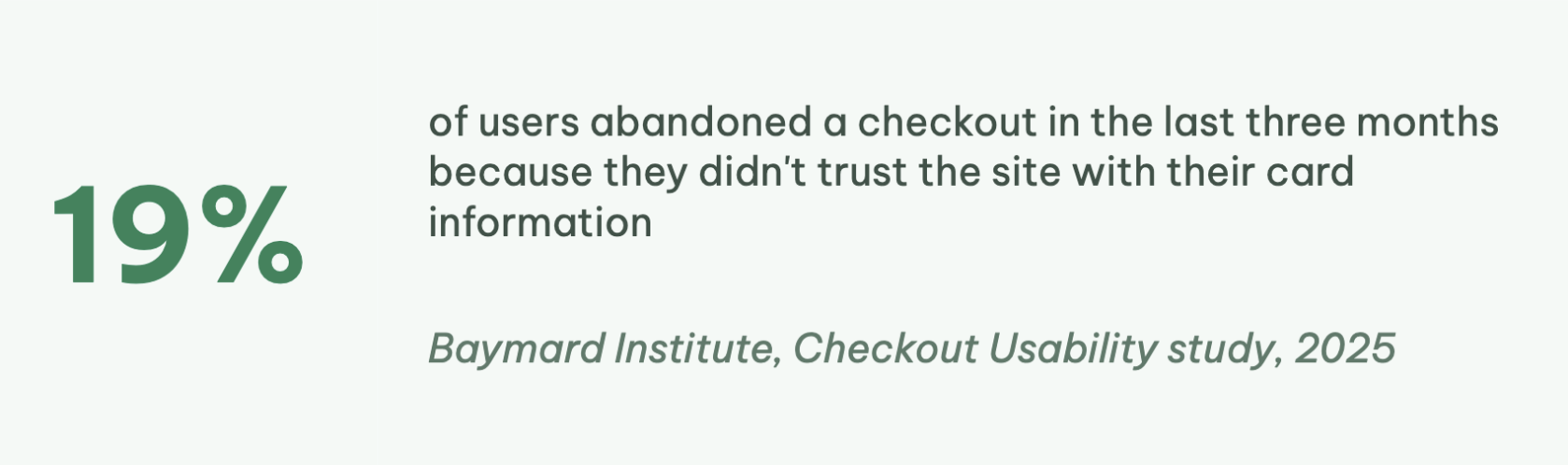
Most Shopify stores lose the sale long before a shopper weighs the price, and the reason is rarely the product. It is disbelief.
Distrust is the starting posture of the modern shopper, and the Edelman Trust Barometer makes the point bluntly. In the 2026 edition, Richard Edelman wrote that "distrust is the default instinct; only one-third of respondents tell us that most people can be trusted" (Edelman, 2026 Edelman Trust Barometer). A first-time visitor who has never heard of your brand arrives already skeptical, and everything on the page is either closing that gap or widening it.
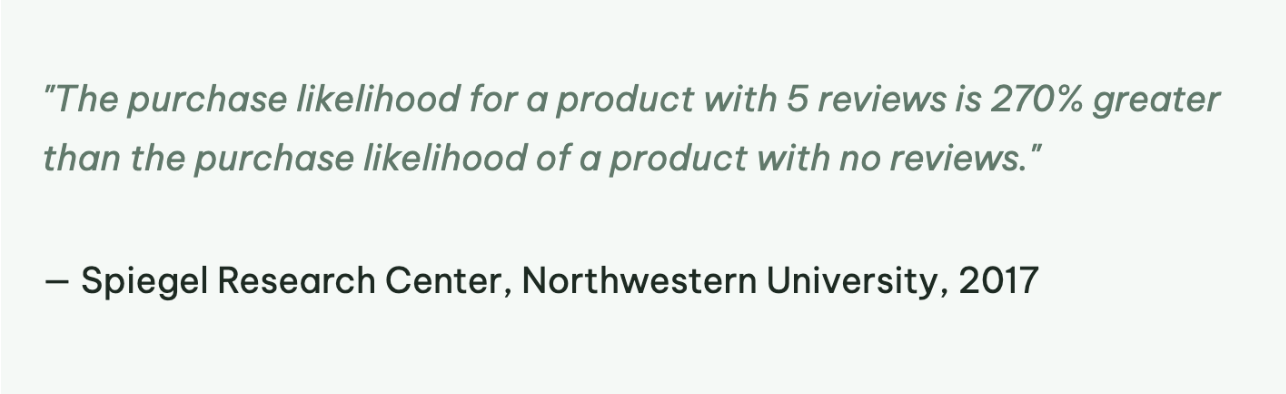
The cost of the gap is measurable. Northwestern University's Spiegel Research Center, working with PowerReviews data, found that displaying reviews can increase conversion by up to 270% compared with a product that has none, and that for higher-priced items the lift reached even further. Shoppers want proof, and the absence of proof carries a price you pay in lost carts.
The Trust Hierarchy
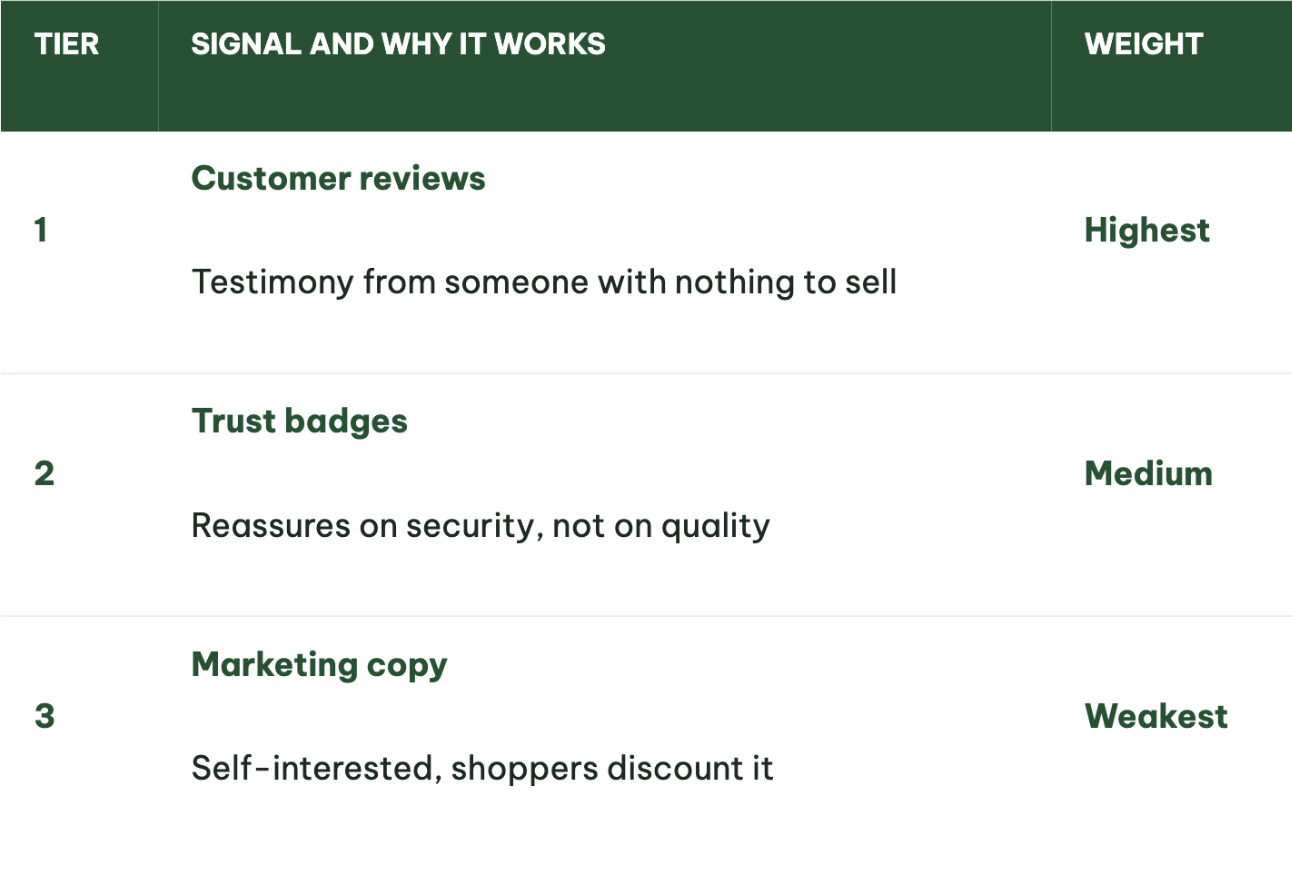
Not all trust signals carry equal weight. Ranked by how much shoppers actually trust them, the order is consistent across the research.
Tier 1, Reviews, the Heaviest Lifter
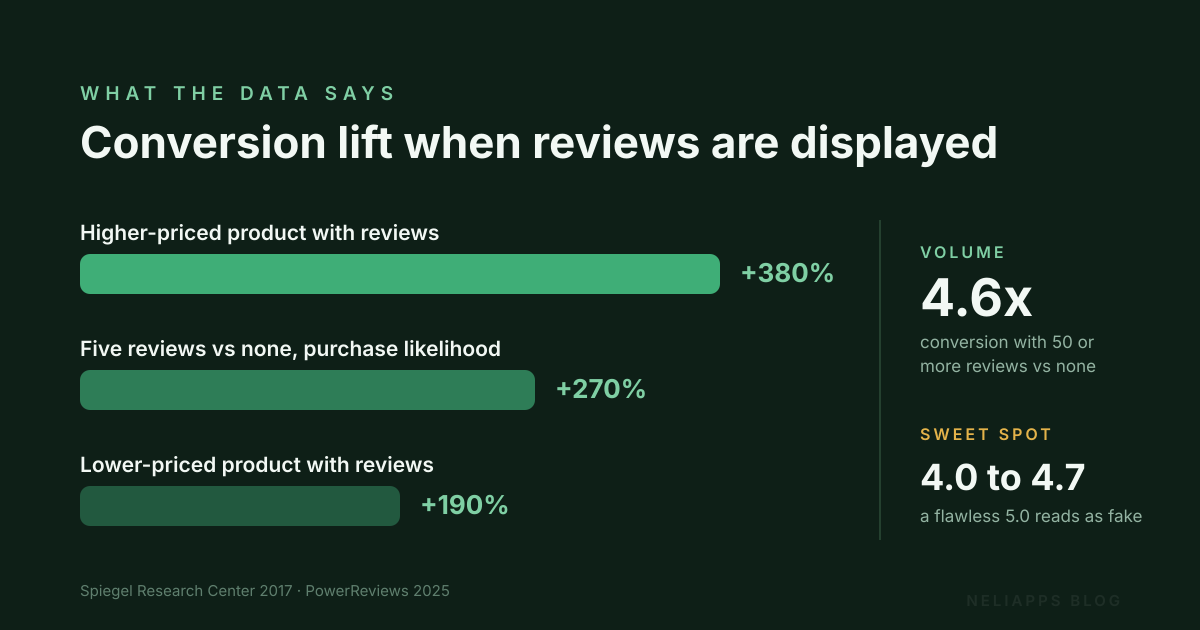
The Spiegel study measured the conversion lift directly, and the effect compounds with volume.
Most of that increase arrives inside the first ten reviews. PowerReviews, analyzing consumer activity across more than 1.5 million product pages, reports that visitors who interact with reviews convert 108 to 120% higher than those who do not (PowerReviews, 2025). Reviews win because they are testimony from someone with nothing to sell.
Tier 2, Badges, Reassurance not Proof
Trust badges genuinely move perceived security, but they operate as reassurance rather than proof of quality. Baymard's site-seal survey of 2,510 respondents ranked the badges shoppers trust most:
- Norton · 35.6%
- McAfee Secure · 22.9%
- Don't know or no preference · 48.7%
Baymard also found that perceived security is largely a gut feeling driven by how secure a page looks, to the point where even a plain do-it-yourself seal raised trust. Badges reassure. They do not tell a shopper the product is good.
Tier 3, Copy, the Weakest Signal
Your own marketing language is the weakest signal precisely because it is self-interested. Robert Cialdini's principle of social proof explains the mechanism.
"We view a behavior as more correct in a given situation to the degree that we see others performing it."
— Robert Cialdini, Influence: The Psychology of Persuasion, 2009
When a shopper is uncertain, they look to other buyers, not to the seller's adjectives.
What the Data Actually Says
Volume Compounds
PowerReviews found that products with 50 or more reviews convert at 4.6 times the rate of products with none (PowerReviews, 2025), and that younger shoppers weight review count even more heavily than older ones. Review coverage is not a vanity metric. It is a conversion lever with no visible ceiling in the data.
The Star Rating has a Sweet Spot
Spiegel found that purchase likelihood peaks for ratings in roughly the 4.0 to 4.7 range and then declines as ratings approach a flawless 5.0, because shoppers read a perfect score as "too good to be true" (Spiegel Research Center, 2017). A scattering of critical reviews is an asset, not a liability.
Trust Now sits alongside Price and Quality
Edelman's 2025 Brand Trust special report, "From We to Me," found that 80% of people trust the brands they use, placing brand trust ahead of trust in government, media, and other institutions, and framed trust as a purchase consideration equal to cost and quality (Edelman, 2025 Brand Trust Special Report). For a store, that means trust-building is revenue work, not brand fluff.
Why Traditional Trust Signals Fail
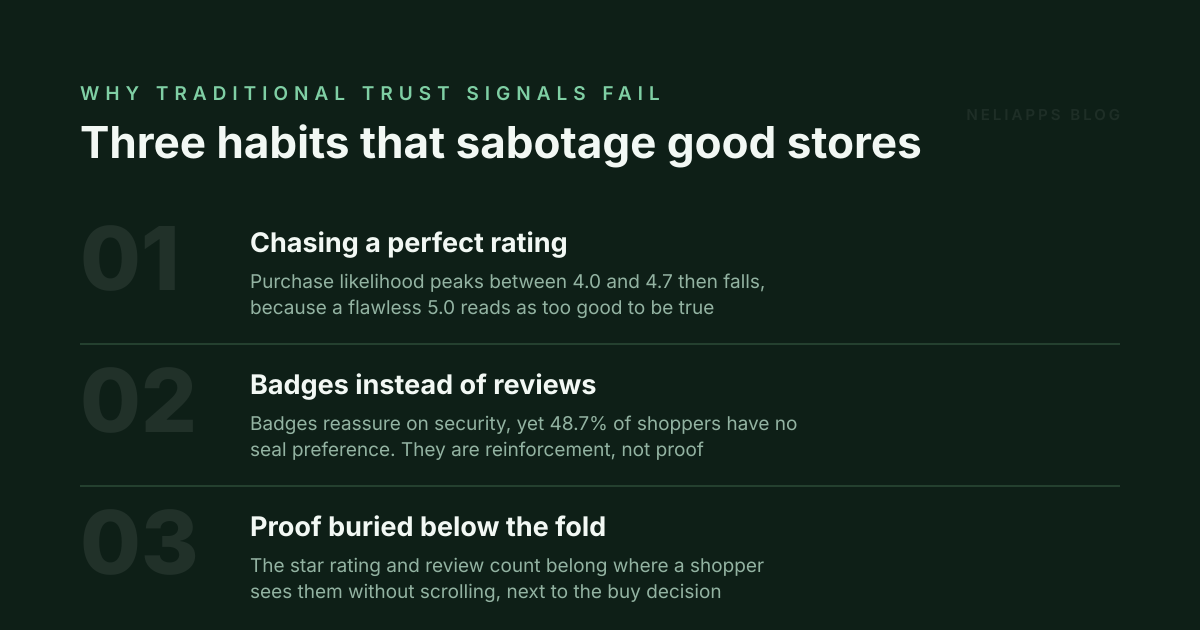
- Inverted hierarchy. Leaning on copy while burying reviews below the fold puts the weakest signal on top and the strongest one out of sight.
- Badge-only trust. Treating badges as a substitute for social proof rather than a supplement to it. Badges reassure on security, they do not prove product quality.
- Suppressing criticism. Scrubbing every negative review in pursuit of a spotless page. A wall of nothing but five-star reviews reads as manufactured, and authenticity is itself a conversion factor.
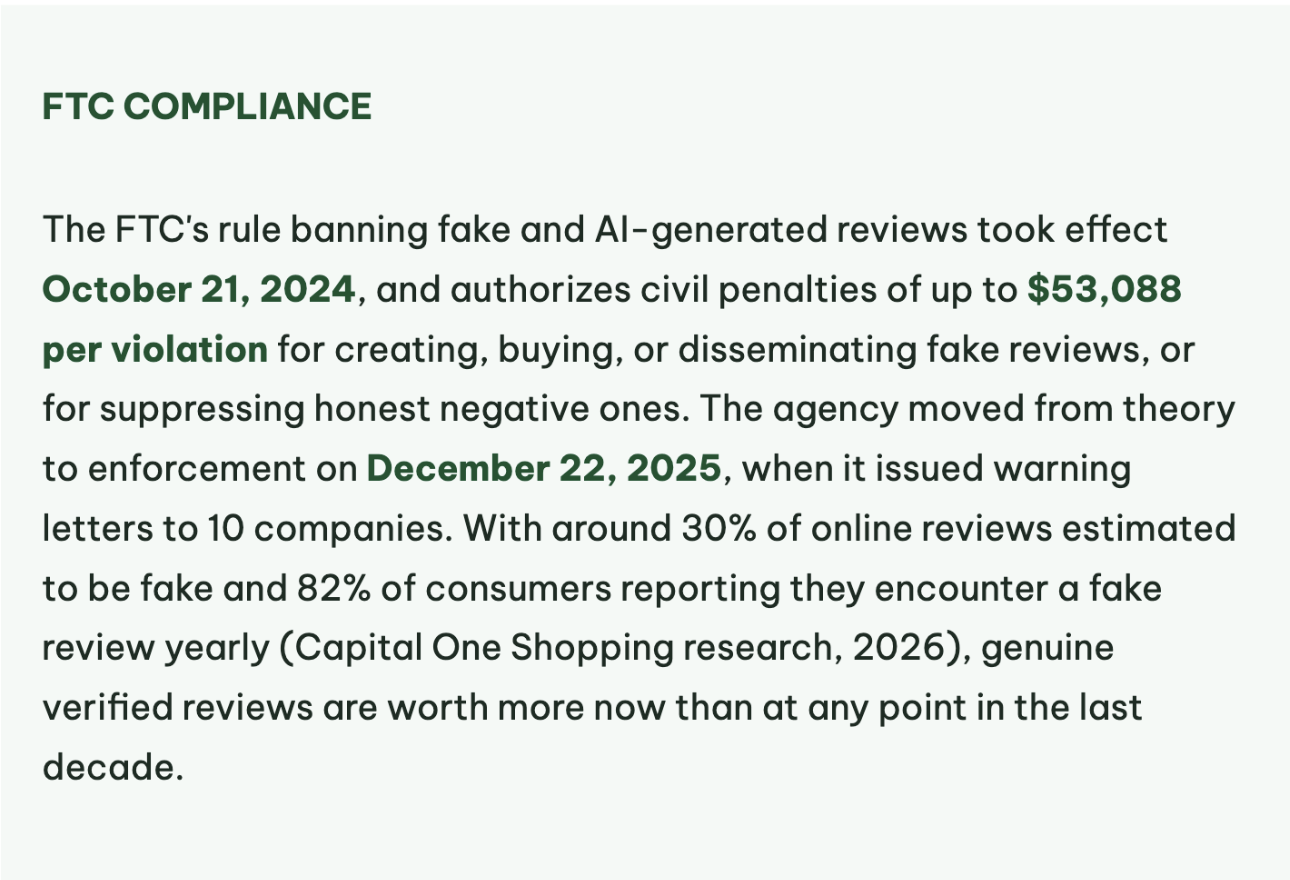
Honesty is both the compliant choice and the higher-converting one.
How to Build Layered Trust
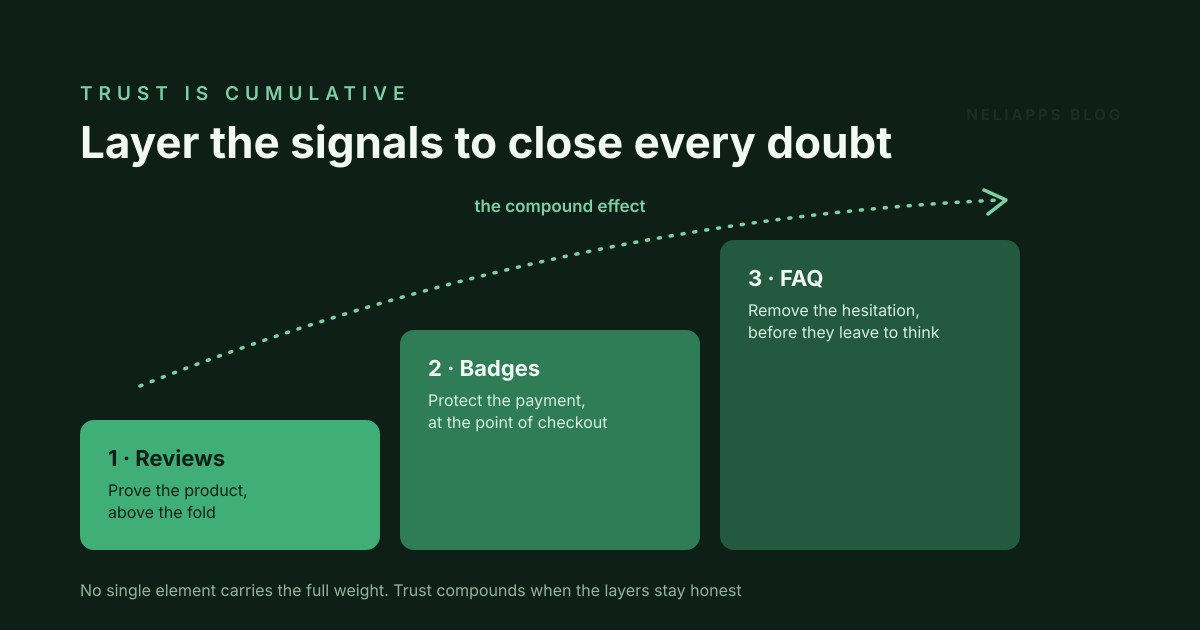
The winning approach stacks signals in the order shoppers value them. Begin with the review layer, because it does the heaviest lifting, and mark reviews as verified so shoppers can see they come from real buyers. Support that foundation with perceived-security cues, such as recognizable badges placed near the payment fields where doubt spikes. Then close the objection loop with a clear, well-organized FAQ that answers the questions that quietly stall a purchase, from sizing to returns to shipping time.
The neliApps conversion apps map cleanly onto these layers:
- NL Product Reviews handles the review foundation, the tier that does the heaviest lifting.
- NL Trust Badges reinforces perceived security at the point of payment, where doubt spikes.
- NL FAQ Page absorbs the objections that would otherwise send a shopper away to think it over.
The point is not any single app but the layering, because trust is cumulative and no single element carries the full weight.
A Worked Example
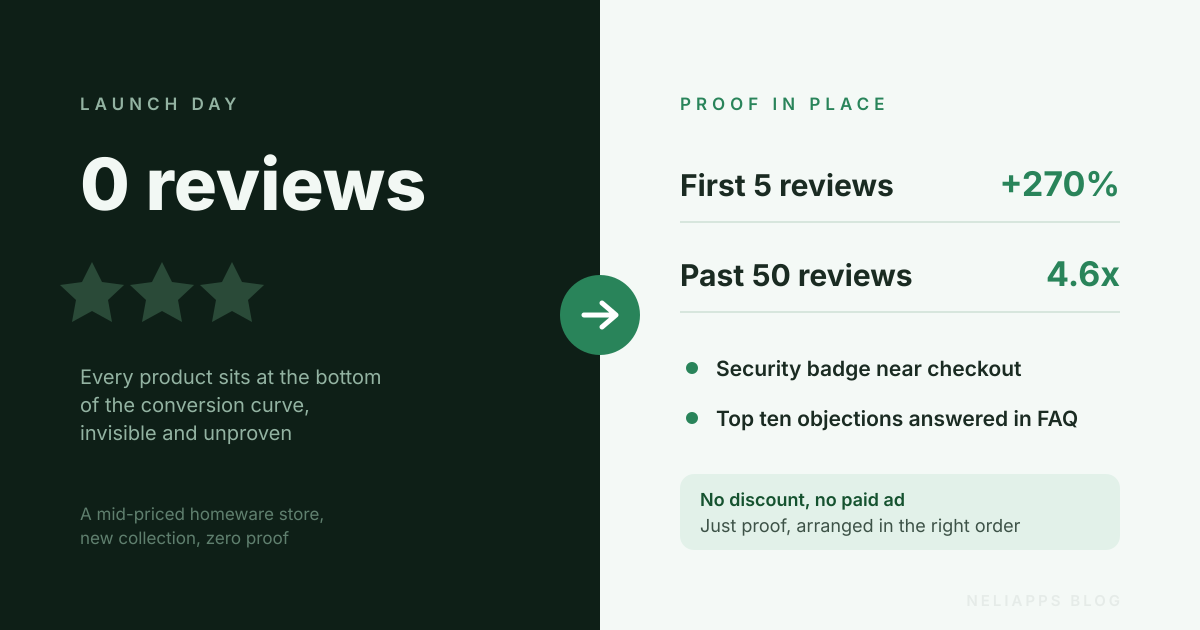
Picture a mid-priced homeware store launching a new collection. With zero reviews, every product sits at the very bottom of the Spiegel conversion curve, invisible and unproven.
Collecting the first five reviews per product moves each listing into the zone where Spiegel measured a 270% lift, and pushing past 50 reviews approaches the 4.6-times territory PowerReviews documents. The same store, if it also displays a recognizable security badge near checkout and answers its top ten objections in an FAQ, compounds the review gain with the perceived-security gain Baymard describes.
None of these numbers require a discount or a paid ad. They require proof, arranged in the right order.
Best Practices
- Lift the review snippet above the fold so a shopper sees the star rating and review count without scrolling.
- Aim for an honest 4.2 to 4.7 average. A perfect 5.0 reads as manufactured and pushes shoppers toward disbelief.
- Never suppress genuine critical reviews. They authenticate the positive ones and demonstrate authenticity.
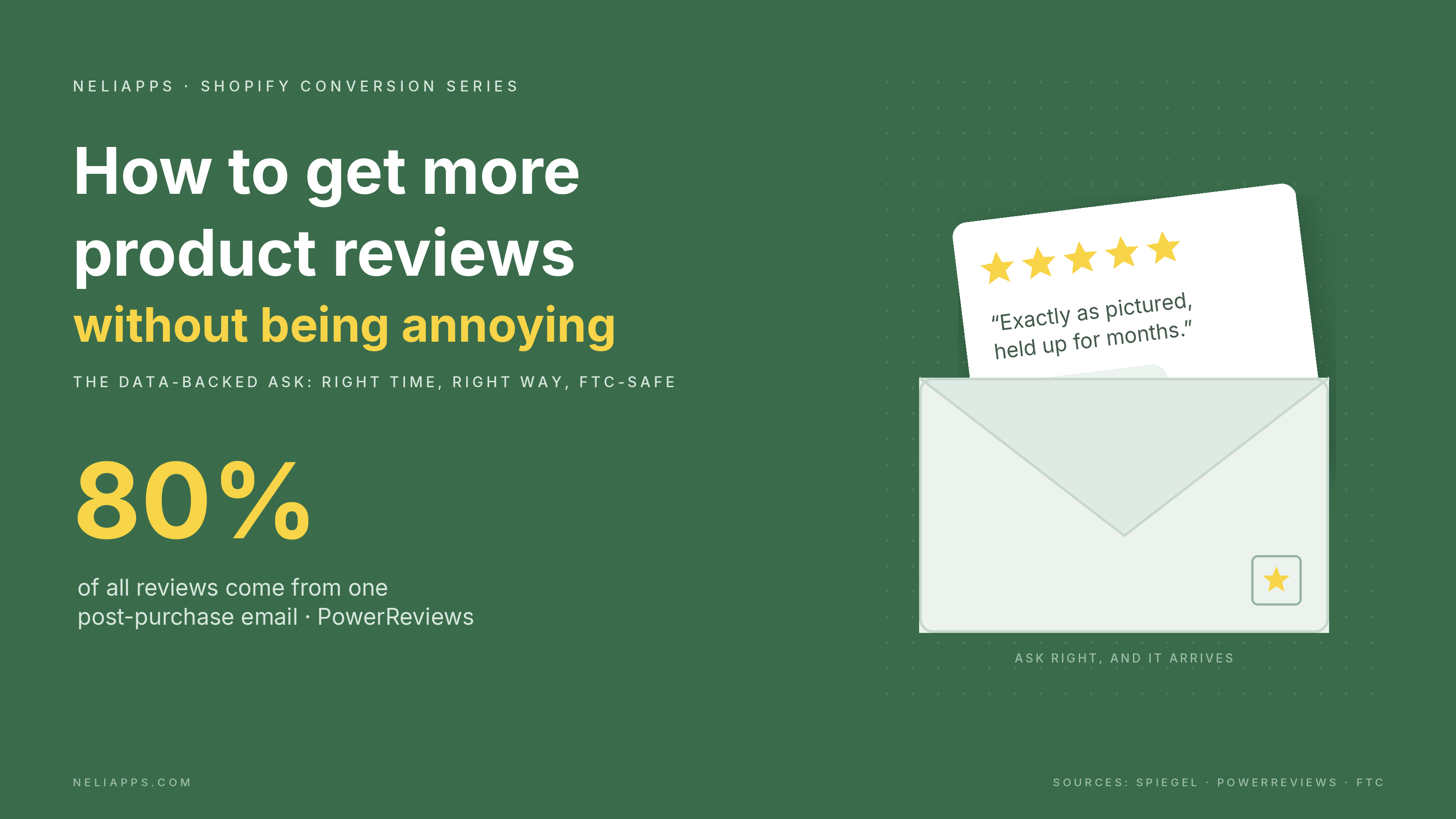
- Automate review requests 7 to 10 days after delivery, when the product experience is still fresh in the buyer's mind.
- Stay firmly on the right side of the FTC rule by never conditioning an incentive on a positive sentiment.
- Treat badges and FAQs as reinforcement for reviews, not replacements for them.
.png)