
.png)
TL;DR
- Discounting buys a short revenue bump at a permanent margin cost, and it trains customers to wait for the next markdown. The more durable path to a higher average order value (AOV) is to help shoppers build a bigger, more useful basket at full price.
- Five non-discount levers move AOV reliably: product bundles and volume tiers, relevant cross-sells, order thresholds with progress messaging, trust and social proof that de-risk larger purchases, and pre-orders that capture demand early.
- Every tactic below is tied to a named, verifiable source. Start by measuring your mean, median, and mode order values, then sequence the levers against your actual basket distribution rather than copying a competitor.
Introduction
A 5% improvement in customer retention can lift profits by 25% to 95%, a finding Bain & Company first published with Frederick Reichheld in the Harvard Business Review and one that remains the most cited number in retention research. The reason it matters for a conversation about average order value is simple. Both retention and AOV belong to the same family of growth levers, the ones that extract more value from demand you have already paid to acquire, rather than buying more traffic at rising cost. The same body of Bain and Harvard Business Review work holds that acquiring a new customer costs five to 25 times more than retaining one, which is exactly why squeezing more value from each existing order has become the sharper play.
Most Shopify merchants reach for discounts first because they are fast and easy to launch. The problem is that a discount is the only AOV tactic that lowers the value of every order it touches. This article lays out the alternative: a set of merchandising and trust levers that raise basket size at full price. It is written for operators who want the mechanism and the evidence behind each move, not a list of slogans.
Why more discounts is usually the wrong default
Discounting works against the exact metric you are trying to grow. If your AOV is 60 dollars at a 60% gross margin, you keep 36 dollars per order. Offer a blanket 20% discount to lift order size, and even if the average basket climbs, the margin on each dollar collapses. You now need a materially larger basket just to hold the same gross profit you had before. Worse, discounts are sticky in the wrong direction. Once shoppers learn that a store runs frequent promotions, many simply wait, and your full-price conversion rate erodes over time.
There is also a demand-quality problem. Price-led promotions tend to attract deal-seekers with lower lifetime value, while the levers in this article tend to attract shoppers who value convenience, relevance, and confidence. Those are the customers worth building around.
None of this means discounts are never appropriate. Clearing seasonal inventory or rewarding a loyal segment can be sound. The argument is narrower: discounting should not be your default AOV lever, because it is the only one that trades margin for volume by design. There by its no longerr any option to buy the different things without being stitch to discount option rather than being snitch to the better option
Start by knowing your real number
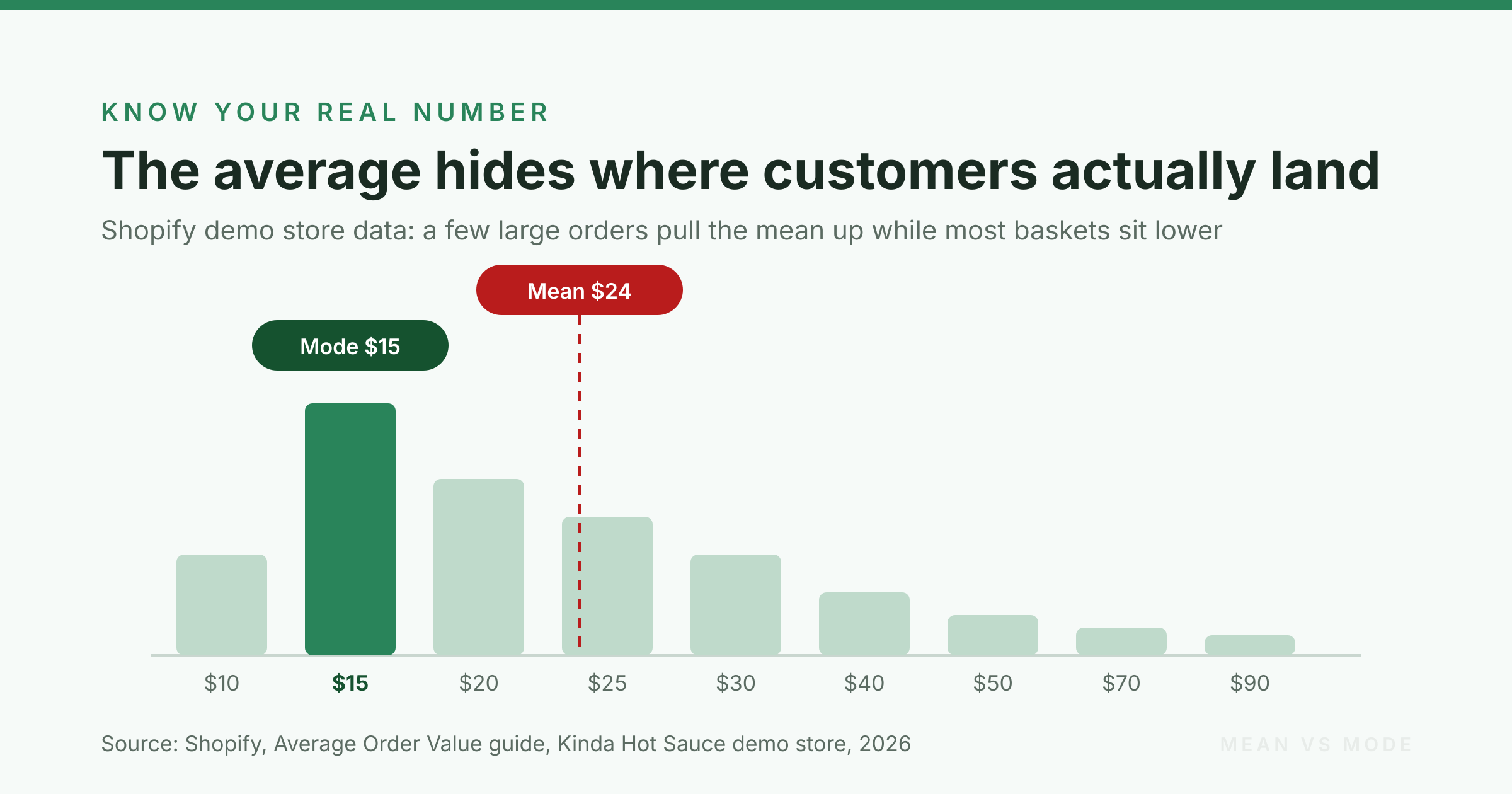
Before touching any tactic, measure AOV correctly. Shopify calculates AOV as net sales divided by order count and displays the mean by default (Shopify, “Average Order Value: Formula and 7 Ways,” 2026). The mean alone can mislead. As Shopify's own guide demonstrates using its Kinda Hot Sauce demo store, the mean order value there is 24 dollars while the mode, the most common order value, is only 15 dollars. A handful of large orders pulls the average up and hides where most customers actually land.
The practical fix is to track three figures together: the mean, the median (the middle order), and the mode (the most frequent order). The mode tells you the basket most of your customers build today, which is the number your thresholds and bundles should be designed to nudge upward. Setting a target off the mean alone routinely produces thresholds and offers that most of your customers cannot realistically reach.
For context, Shopify's 2026 guide states that the global AOV is approximately 145 dollars across all industries, but the spread underneath that average is enormous. Category benchmarks compiled through 2025 put luxury and jewelry baskets often above 300 dollars, apparel in a 40 to 170 dollar band, and beauty in a 15 to 90 dollar band, and desktop orders consistently run larger than mobile. Treat any benchmark as context, not a target. Your category, margin structure, and basket distribution matter far more than a global average.
.png)
Lever one: bundles and volume tiers
Bundling raises AOV by increasing the number of units or the value per transaction while giving the shopper a reason that feels like convenience rather than a hard sell. There are four common formats worth distinguishing.
Classic curated bundles group complementary products into a single purchase, for example a skincare routine or a camp cooking kit. Volume tiers, the buy more, save a little more structure, reward larger quantities of the same product. Buy X Get Y offers pair a driver product with an attach item. Mix and match lets the shopper assemble their own set from an eligible collection.
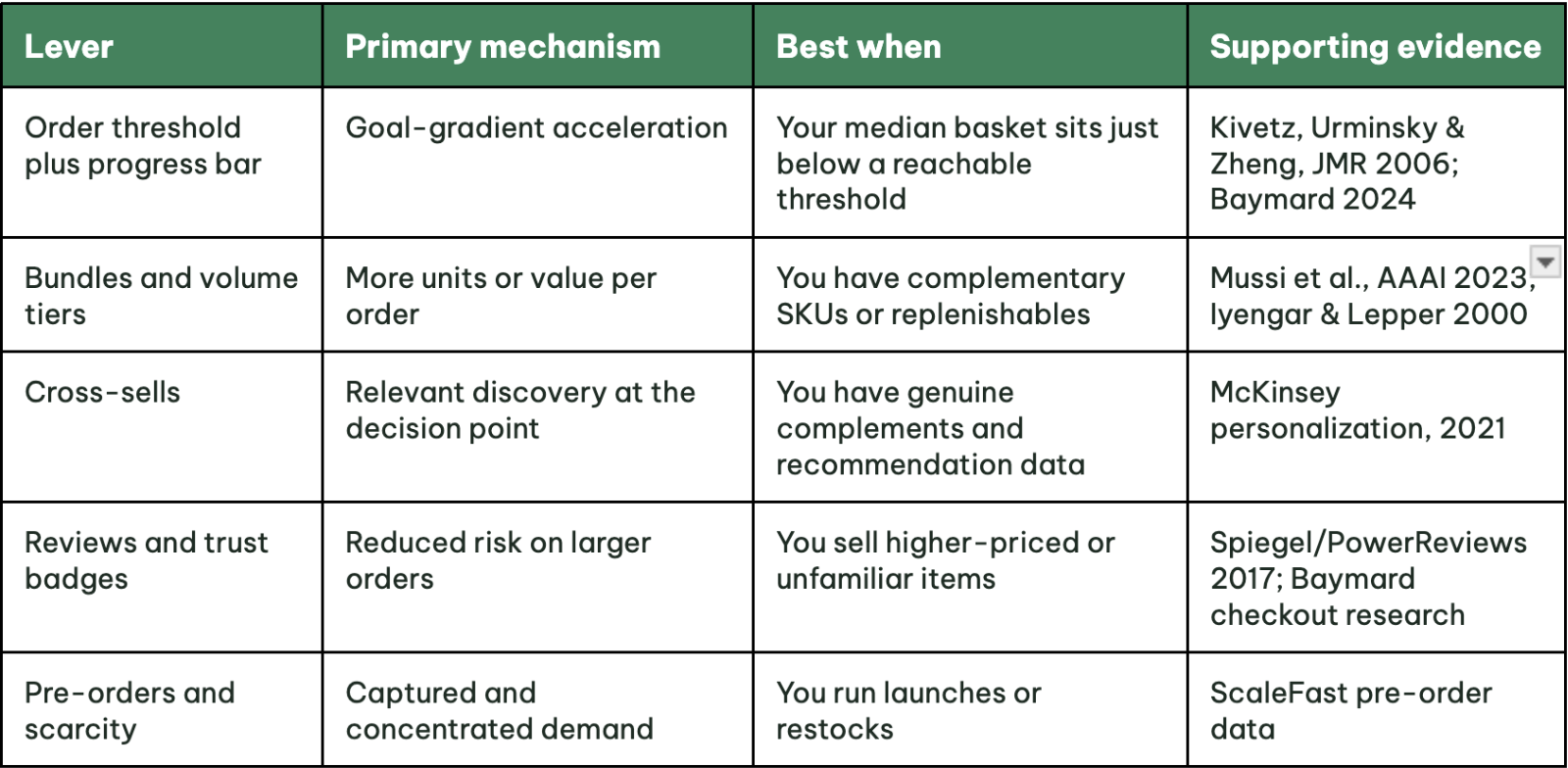
The strongest primary evidence sits with volume tiers, and it comes from a genuine field experiment rather than a vendor estimate. In a four-month controlled A/B test run with an Italian ecommerce company and published by Mussi and colleagues from Politecnico di Milano (AAAI 2023, arXiv:2211.09612), a volume-discount pricing algorithm over roughly 300 products produced a total turnover of about 300,000 euros and outperformed the human-specialist configuration by about 55% in total profit. The company was convinced enough to adopt the approach for more than 1,200 products since January 2022. The mechanism that drove the gain was order size: the algorithm shifted purchases out of the smallest basket tier and into larger ones, with the highest-volume products showing a marked rise in average units per basket. That is a real order-size effect measured in the field.
A caution on the widely repeated claim that McKinsey says bundling lifts revenue 20% and profits 30%. That figure comes from a McKinsey client case study about cross-selling and category penetration for a single online retailer, not a general bundling benchmark. The related 5 to 15% revenue lift number is from McKinsey's personalization research, not bundling. Attribute these accurately or not at all. The honest summary is that bundling has strong practitioner support and one solid field study on volume tiers, and you should validate the lift on your own catalog.
Two design rules keep bundles profitable. First, keep any bundle incentive shallow. A curated set can win on convenience and perceived value with little or no price concession, and deep bundle discounts erase the AOV benefit you were chasing. Second, respect choice limits. Iyengar and Lepper's field experiment in an upscale grocery store, published as “When Choice Is Demotivating” in the Journal of Personality and Social Psychology (2000), found that shoppers presented with 6 jam varieties were far more likely to buy than those shown 24, roughly 30% versus 3% purchase rates. A bundle builder with too many permutations can suppress the very purchase you want. Offer a few strong, legible options.
Lever two: cross-sells and complete the look
Where bundles are built in advance, cross-sells are contextual suggestions surfaced at the right moment: a complete the look module on a product page, a frequently bought together block, or an add-on prompt in the cart. The mechanism is discovery. A relevant suggestion helps a shopper find something they would have wanted anyway, which is why it can raise basket size without feeling like a hard sell.
Personalized recommendation quality is what separates a lift from an annoyance. McKinsey's research (Next in Personalization 2021 Report, and “The value of getting personalization right, or wrong, is multiplying,” 2021) finds personalization most often drives a 10 to 15% revenue lift, with company-specific results spanning 5 to 25% depending on sector and execution. A widely cited McKinsey figure also attributes about 35% of Amazon's revenue to its recommendation engine, a number frequently quoted secondhand, so treat it as directional rather than precise.
The practical takeaway is relevance over volume. Recommending your bestsellers to everyone wastes the slot, because those customers were likely to find them anyway. Suggesting the genuinely complementary item, the strap for the bag, the blades for the razor, is where the incremental order size lives.
Lever three: order thresholds and progress messaging
.png)
The order threshold is the single most reliable non-discount AOV lever, and it works because of a well-documented behavioral effect. Kivetz, Urminsky, and Zheng, in “The Goal-Gradient Hypothesis Resurrected” (Journal of Marketing Research, 2006), showed that people accelerate effort as they get closer to a reward. In their café field experiment, customers bought coffee more frequently the nearer they were to earning their reward. A cart that shows a shopper they are a few dollars away from a benefit taps the same acceleration.
The most common application is the shipping threshold, the order minimum that unlocks a delivery offer. Unexpected extra costs at checkout are the leading fixable reason shoppers abandon carts. In Baymard Institute's 2024 survey, among shoppers who abandoned for an actionable reason rather than mere browsing, the ranked causes were extra costs like shipping (39%), required account creation (24%), slow delivery (21%), and distrust of the site with card information (19%). A threshold reframes that top friction as a goal. Rather than surprising the shopper with a shipping fee, you show them how to avoid it by adding one more item. Peer-reviewed work supports the effect: Lewis, Singh, and Fay's analysis of retailer data found that offering delivery above a minimum order value is an effective way to generate additional sales, and Forrester Consulting reported retailers seeing a 10 to 20% revenue increase while such a policy was in place.
Two implementation notes matter. First, set the threshold above your current typical basket but within reach. A common practitioner guideline is 20 to 30% above your AOV, but this only works if you set it against your median or mode, not a mean inflated by outliers, or you will place the goal out of reach for most shoppers. Second, make the progress visible. A persistent announcement bar that states the threshold before browsing begins, plus a cart progress indicator that counts down the remaining amount, turns a passive policy into an active goal. The announcement bar earns awareness; the progress indicator earns the goal-gradient acceleration.
Lever four: trust and social proof that unlock bigger baskets
.png)
The larger the order, the more confidence a shopper needs to complete it. This is where social proof and trust signals convert directly into order size, because they reduce the perceived risk of committing more money.
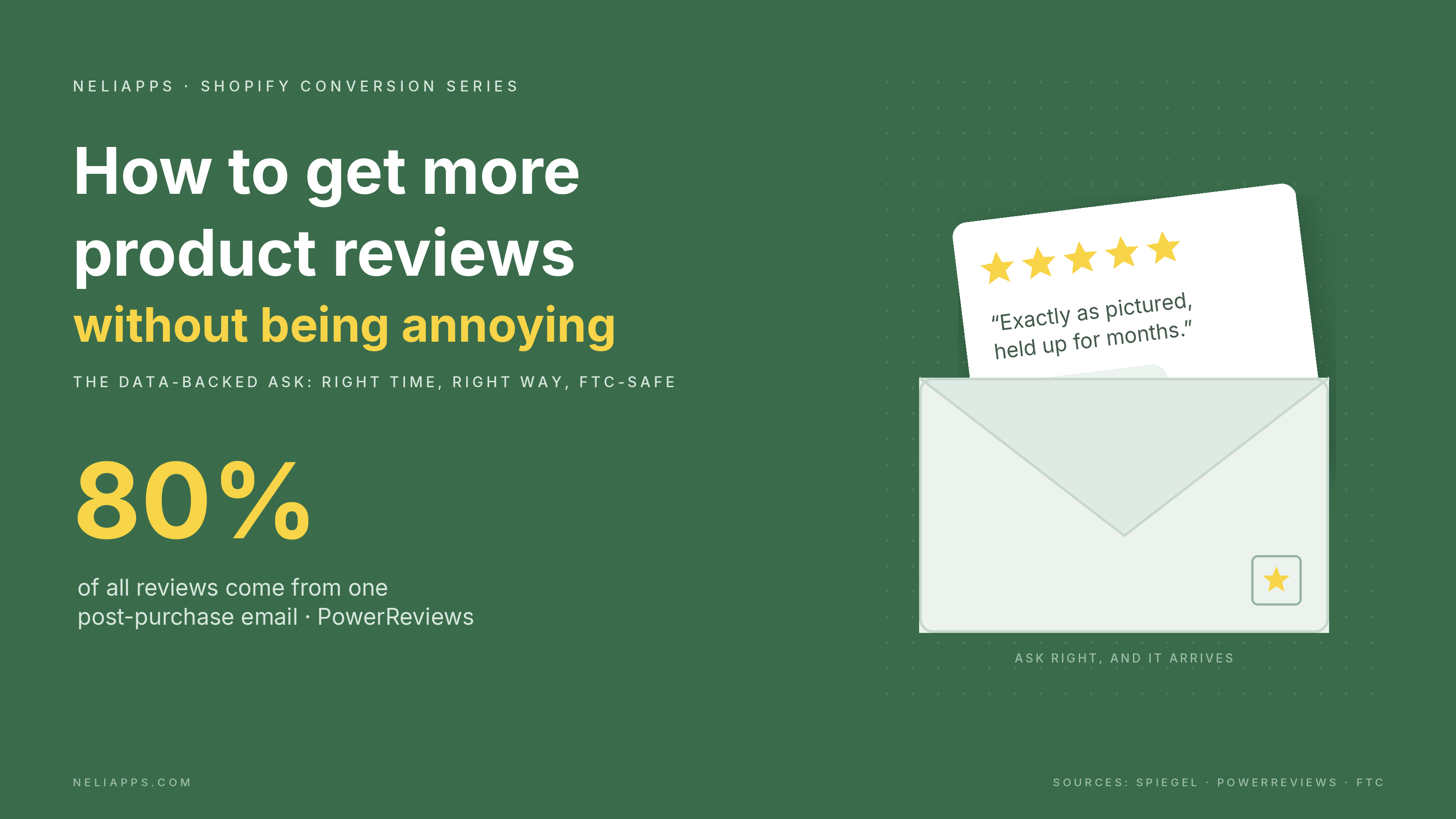
The review evidence is strong and specific. Northwestern University's Spiegel Research Center, using PowerReviews data, found in “How Online Reviews Influence Sales” (2017) that a product page with five reviews has a 270% higher purchase likelihood than a page with none, and that the effect is larger for higher-priced items. In the same study, displaying reviews lifted conversion 190% for a lower-priced product but 380% for a higher-priced one. The first five reviews carry the most weight, after which the marginal benefit diminishes. The implication for AOV is direct: reviews matter most on exactly the expensive, high-consideration items you want in bigger baskets.
Shoppers act on this. In PowerReviews' Ever-Growing Power of Reviews (2023 edition, a survey of 8,153 US consumers), 45% said they would not buy a product with no reviews, 78% said the more expensive the product the more they read reviews, and 98% were more likely to read reviews for a product they had never bought before.
Checkout trust signals close the loop. In Baymard Institute's Checkout Usability research, 19% of users have abandoned a checkout flow during the last three months because they did not trust the site with their credit card information (1,026 respondents representative of the average US adult internet population). Baymard also finds that visual security cues, site seals and badges placed near the payment fields, raise the shopper's perceived security, an effect strongest for lesser-known brands where trust is not already assumed. Trust badges do not fix a broken checkout, but on higher-value orders they remove the last hesitation.
Lever five: pre-orders and honest scarcity
Pre-orders capture demand that would otherwise leak away when an item is out of stock or not yet released, and they concentrate buying intent. According to ScaleFast data (via X-Cart), 28% of sales of an entire pre-order campaign happen on the very first available day for popular launches, and over 50% of pre-order visitors are new visitors to the website, while for less popular niches the first-day figure is around 15 to 18%. That combination, front-loaded demand plus new-customer reach, makes pre-orders a useful AOV and acquisition tool when you have a launch or a restock to build around.
Scarcity works alongside pre-orders by reducing hesitation, but only when it is genuine. Honest low-stock indicators and real deadlines pull forward purchases that might otherwise be delayed or abandoned. The ethical and practical line is the same one: fabricated countdowns and fake stock counts destroy trust permanently once discovered, and they undercut the review and badge work from the previous section. Use scarcity to communicate real limits, not to manufacture false ones.
Sequencing the levers
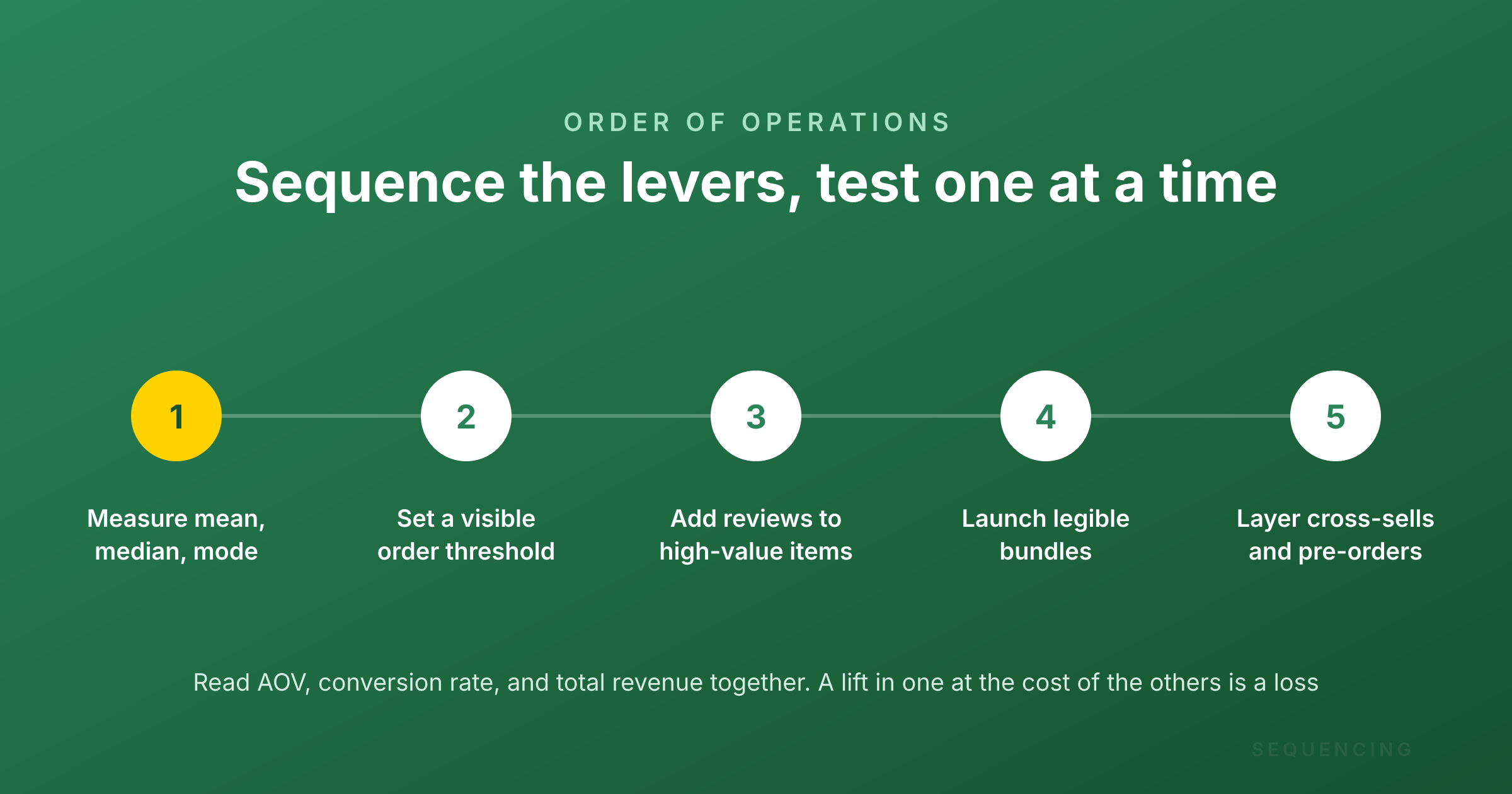
The levers are not equal for every store, and layering all of them at once makes it impossible to learn what worked. Sequence them against your basket distribution.
A workable order of operations for most stores: measure mean, median, and mode first; set a shipping threshold tuned to your median and make progress visible; add reviews to your highest-value products; introduce one or two legible bundles; then layer cross-sells and pre-orders as you learn.
Best practices
Test one lever at a time and read AOV, conversion rate, and total revenue together. A threshold that lifts AOV but drops conversion enough to reduce revenue is a loss, not a win, which is why margin-aware measurement matters more than the headline AOV number.
Protect margin explicitly. Keep bundle and tier incentives shallow, because deep concessions reproduce the discount trap this article is designed to help you escape.
Respect the shopper. Keep bundle choices few and legible, keep recommendations genuinely relevant, and keep scarcity honest. Every one of these levers depends on trust, and trust is the asset that discounting quietly spends down.
FAQ
What is a good average order value on Shopify?
There is no universal number. Shopify's 2026 guide puts the global AOV at approximately 145 dollars across all industries, but it varies widely by category and device, with luxury and jewelry baskets often above 300 dollars and beauty baskets in a 15 to 90 dollar band. Benchmark against your own category and, more usefully, against your store's trend over time.
How can I increase average order value without discounts?
Focus on levers that raise basket size at full price: order thresholds with visible progress, curated bundles and volume tiers, relevant cross-sells, reviews and trust badges on higher-priced items, and pre-orders for launches. Each is supported by named research cited in this article.
Where should I set my shipping threshold?
Set it above your typical basket but within reach, commonly 20 to 30% above your AOV, and crucially calculate it from your median or mode rather than a mean inflated by a few large orders. Then make it visible with an announcement bar and a cart progress indicator so shoppers feel the goal.
Do product reviews really affect how much people spend?
Yes, and the effect is larger on expensive items. The Spiegel Research Center found a product with five reviews has a 270% higher purchase likelihood than one with none, and that displaying reviews lifted conversion 380% for a higher-priced product versus 190% for a lower-priced one (2017).
Is bundling better than discounting?
Generally yes for margin, because a curated bundle can win on convenience and perceived value with little or no price concession, whereas a discount lowers the value of every order it touches. Keep bundle incentives shallow so the AOV gain is not given back at the register.
Are pre-orders worth it for a small store?
They can be, particularly around a launch or restock. Pre-orders capture demand that would otherwise be lost to out-of-stock states, concentrate buying intent early (ScaleFast data shows 28% of a popular campaign's pre-orders land on day one), and tend to reach a high share of new visitors, which adds an acquisition benefit on top of the order.
Conclusion
Raising average order value without leaning on discounts is not a single trick. It is a system: know your real numbers, then use merchandising and trust to help shoppers build bigger, more useful baskets at full price. The evidence points the same way across every lever. Goal-gradient thresholds accelerate the last few dollars of a cart, relevant recommendations surface genuine complements, reviews and badges unlock the confidence that larger orders require, and honest scarcity and pre-orders concentrate demand you already have. Each one compounds with the others, and none of them spends down your margin the way a markdown does.
Work with the neliApps conversion apps
If you want to put these levers to work, a few of the neliApps conversion apps map directly onto the strategies above. NL Product Bundles supports curated bundles, volume tiers, and mix and match, so you can raise units per order at full price. NL Announcement Bar carries your threshold message sitewide so shoppers know the goal before they browse. NL Product Reviews and NL Trust Badges add the social proof and checkout confidence that larger orders depend on, and NL Pre-Orders captures demand around launches and restocks.
Install on Shopify now →
NeliApps · neliapps.com · business@neliapps.com
.png)